Live the Story: Why Gaudio Dub is the Answer
2026.03.30ㆍ by Anne Kim

Gaudio Dub


Introducing Gaudio Dub through real dubbing projects and what we learned from them


Gaudio Lab brings a tremendous range of technologies to bear on a single piece of content. DME separation, voice replacement, holistic content analysis, language localization, voice casting, emotion mapping, mixing and mastering — we are an AI tech company that has won six CES Awards over four consecutive years!
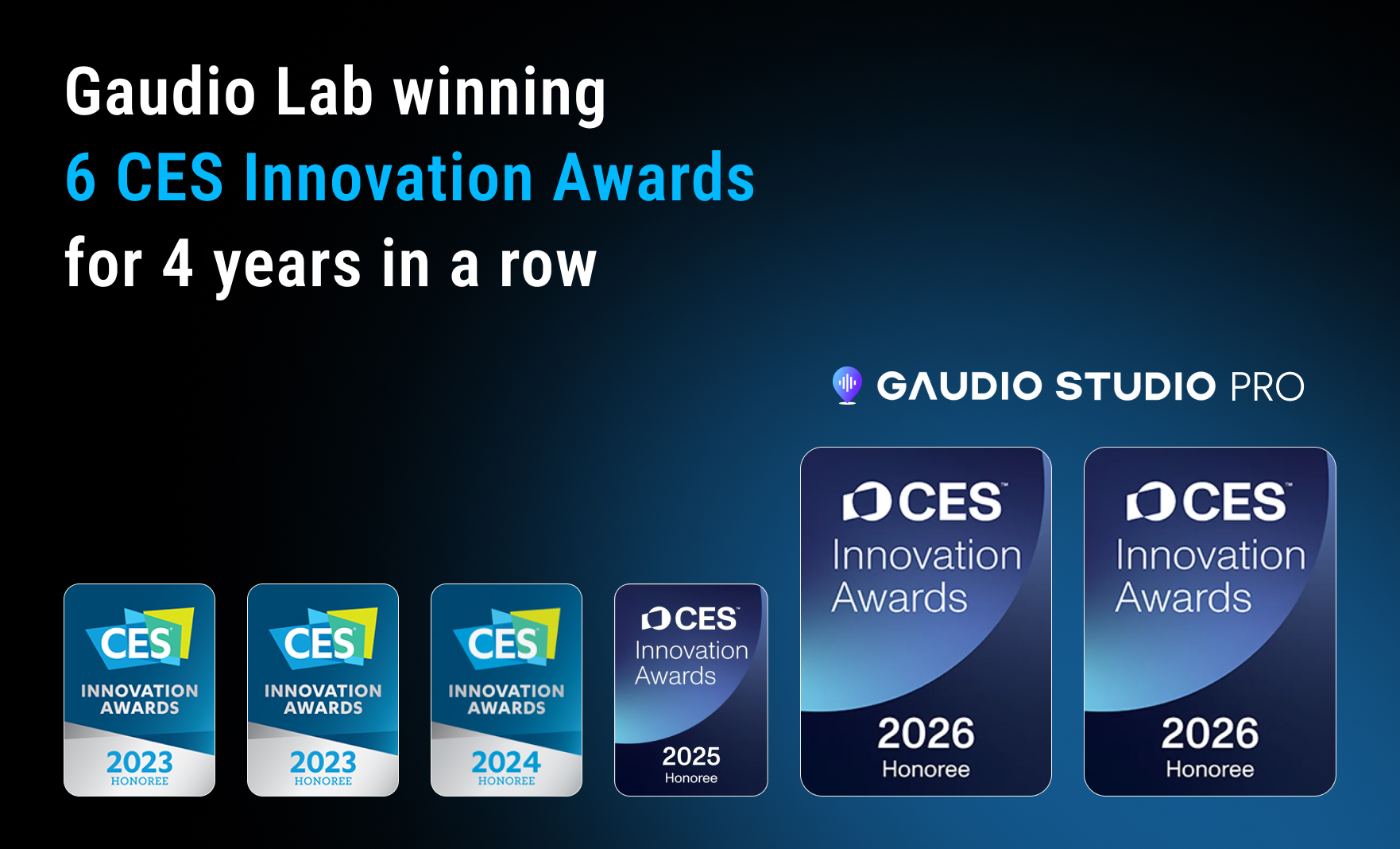


Gaudio Lab won 6 CES Innovation Awards
 

Yet, this post is less about the technology and more about the real dubbing projects we have taken on — and the hard-won know-how we have built along the way.


Do you prefer subtitles or dubbing when watching foreign-language content?


Every piece of content has something the viewer needs to focus on. In a film, it is the actors' expressions. In a sports or esports broadcast, it is the action itself. Yet most people are still more accustomed to subtitles than dubbing. The problem is that a viewer reading subtitles is only half-watching the screen. In the very instant an actor's face contorts with emotion, their eyes are chasing text at the bottom of the frame. Dubbing gives those eyes back to the screen.

This is exactly why global OTT platforms are looking beyond subtitles to dubbing — they understand the value of letting viewers live the story while watching the content.


We live in a world where AI generates images and creates videos. Now it does dubbing, too. But whenever the topic of AI dubbing comes up, the reactions tend to sound similar


"AI dubbing? How is that any different from just running TTS?"

"Sure, it's fast — but the quality… I've listened to a few and honestly, it's not there yet."


Given the quality of most AI dubbing services on the market, these reactions are understandable. Upload a video, press a button, get a result. Fast and convenient. But anyone can tell it was generated by AI. For a knowledge-based YouTube video, that might be good enough. But demand for dubbing is rapidly spreading to short-form content, variety shows, films, dramas, and beyond.


Fast delivery. High quality.


So — can AI dub an entire drama? At broadcast-ready quality?

With today's technology, that might sound impossible… but as always, Gaudio Lab found a way. And proved that speed and quality are not an either-or proposition. Here is how we achieve AI-level speed without compromising broadcast-level quality, illustrated through several real-world cases.
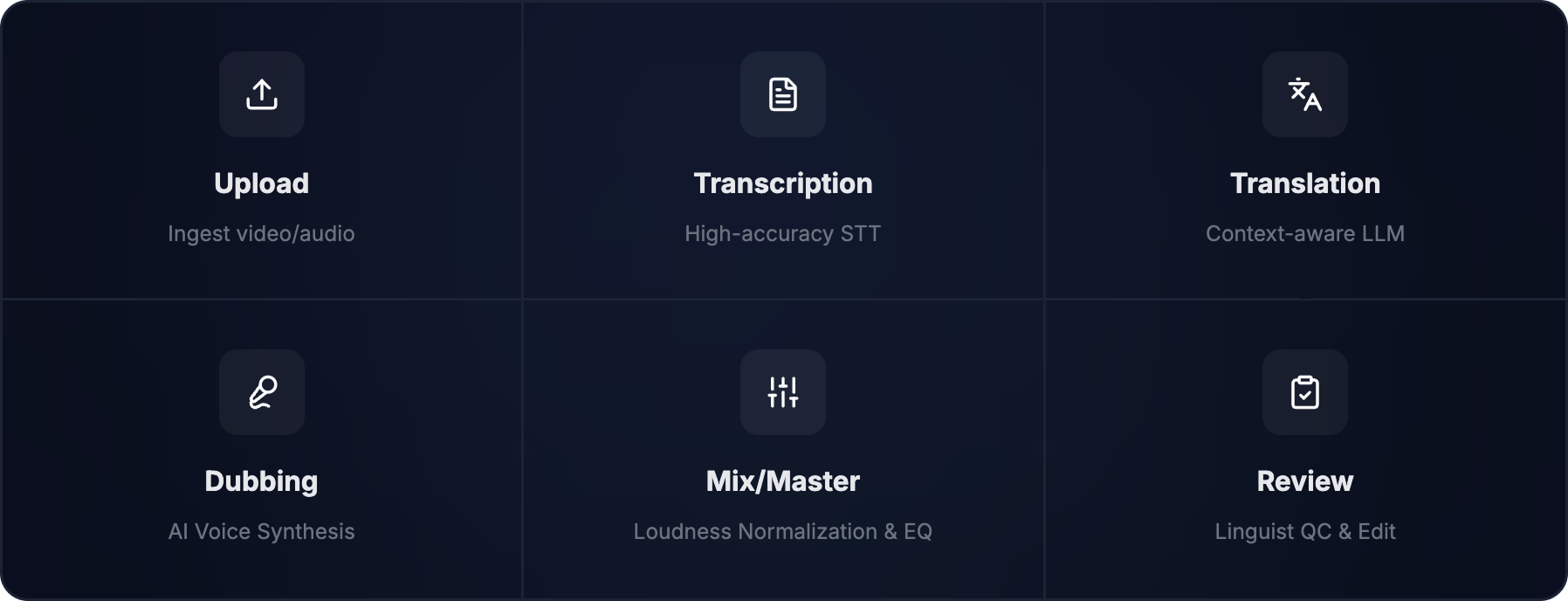
 

Gaudio Dub Workflow


Different content demands different dubbing


Gaudio Lab has dubbed films (romance, courtroom thrillers, campus dramas, horror…), dramas (from romance to over-the-top melodramas), kids' content, variety shows (cooking, mukbang, survival competitions), documentaries, sports and esports broadcasts, animation, corporate videos, dating shows — and more.

The conclusion from all of this work: when the content is different, the dubbing must be different, too. Every genre has its own appeal — and its own hidden challenges. When people ask about AI dubbing, the question is usually "What can the technology actually do?" But once you are in the trenches, the real question becomes "Do you understand what matters most for this specific content?"

Let us walk through a few of those projects to show what we focus on, genre by genre.


Horror Films — AI-Generated Screams… Not Scary at All!!

What makes a horror film terrifying is not just the ghost on screen — it is the sound. The slow creak of a door, the wind howling outside a dark window, a scream… (Personally, the thing that scares me most is the sound of someone holding their breath the moment they sense something is coming.)

So how does an AI-generated scream sound? I cannot watch horror films at all, but when I watched one with AI dubbing, it was surprisingly… not scary. The voices were unnatural enough to break immersion entirely.

This is where humans come in. They do not record the lines themselves, but they guide the AI to generate screams that are genuinely frightening and realistic. Through Gaudio Lab's proprietary emotion mapping expertise, we ensure the AI voice delivers sounds that closely match the original.


Music Survival Shows — 100 Contestants…? How Do You Tell My Bias's Voice Apart?

When we took on a large-scale music survival show, the first challenge we hit was the sheer number of people. A hundred contestants, plus MCs and judges… How do you make each voice distinguishable? That was the core problem.

Simply varying vocal timbre was not enough. No viewer can tell 100 people apart by tone alone. And with that many cast members, the person speaking is not always the person on screen.

So we used our AI voice casting technology to define each character's speech profile — speaking pace, habitual filler words, sentence-break patterns — creating 100 distinct, personality-rich voices. We paid extra attention to the MCs and the contestants who survive to the end, because their voices carry through the entire series.


K-Drama — Recreating the Creator's Intent, Frame by Frame

Drama is the most demanding category. The dubbed version must align almost perfectly with the creator's original intent, and lip sync must be matched frame by frame. The dubbed voice has to land precisely when the actor's mouth opens and closes — but since speech length and rhythm differ fundamentally across languages, achieving this sync is a formidable technical challenge.

The timing of the mouth opening on the original line "거짓말 하지마" has to match the mouth movement on the dubbed line "Stop lying" for it to feel natural — and frankly, that is an extremely difficult problem to solve. For select titles where likeness rights and other clearances have been secured, we have even employed lip-motion technology for the English dub.

On top of that, simultaneous multilingual dubbing amplifies the importance of voice casting per language. Even for the same character, the English and Japanese voices each need to feel natural to their respective audiences — so native-language specialists review everything down to vocal tone.


Esports Broadcasts — Accurate Translation and Natural Commentary Voice Are Everything

What we learned from dubbing esports tournament broadcasts is that translation accuracy matters just as much as the dubbing itself. If game terminology, strategy breakdowns, or real-time play-by-play descriptions are off, viewers notice immediately. The gaming community is extremely sensitive to translation errors. That is why we start by building a rigorously vetted glossary at the translation stage.

At the same time, the transition between a caster screaming with excitement and calmly breaking down a play needs to sound natural. If the voice is tuned only for shouting, it feels off during calm analysis — and vice versa. Maintaining consistency in a single person's voice across excited and composed moments: that is the core challenge of esports dubbing.


(If you're curious about AI translation, one of the steps in Gaudio Lab's dubbing process, please check out this post!)


So you don't just ship the raw AI output as-is?


No. Honestly, for most content, the answer is "not yet." There are areas that AI dubbing still cannot handle on its own. Beyond the examples above:


Emotional nuance is lost. A single line like "Take care" needs to be choked out, barely held together, if the character is fighting back tears — but cold and resolute if they are severing a relationship in anger. AI can express broad categories like "sadness" or "anger," but it cannot yet capture the subtle variations within the same emotion.


Rhythm becomes uniform. Humans naturally pause just before an important word, speed up as emotion builds. AI struggles to reproduce this organic irregularity, so long monologues or emotionally complex lines can end up sounding like a machine reading a script.


Non-verbal vocal nuance is missing. A sigh before a monologue, laughter woven into dialogue, a scream layered over a shout. The difference between speaking while laughing and laughing mid-sentence — AI still cannot nail that from the start.


"Not everyone can do this — that's exactly why we should!"


The list of AI dubbing limitations could go on and on, which naturally raises the question: "So can you even use AI dubbing at all?" But we chose to focus precisely on those limitations. If it is hard, that means not just anyone can do it — and Gaudio Lab happens to be a place full of wonderfully… unusual people who get excited when they find a hard problem to solve.

When a new challenge had us scratching our heads, one colleague said: "Not everyone can do this — that's exactly why we should. Let's figure this one out together."


The approach is clear — don't force AI to do what it can't


So how did Gaudio Lab solve the problem? We drew a precise line between what AI does well and what humans do well, then built a structure where each step runs in parallel. And, the goal is zero compromise on speed or quality — and localized content tailored to the distinct needs of each industry and content type.

For example, in the Voice Casting stage:

  • AI handles content analysis, character profiling, and voice generation.

  • Humans review the auto-generated voice options and select the best AI voice.

Once voices are cast and Dubbing begins:

  • AI generates all dialogue in the target language in one pass.

  • Humans review each scene to refine emotional delivery, lip sync, audio quality, and localization — polishing the final output.


Knowing exactly where AI falls short — HITL


This is why we do not rely on AI alone. We operate a HITL (Human-in-the-Loop) structure with professionally trained AI dubbing producers and language specialists. The key is that humans are not creating everything from scratch — they are completing what AI has rapidly drafted.

To maximize speed, we also transformed the traditional sequential dubbing workflow into a parallel one. While translation is underway, character voices are already being generated. Translation review and AI dubbing run simultaneously. The entire pipeline operates within a single platform — GSP (Gaudio Studio Pro) — eliminating the friction of switching tools or converting files.
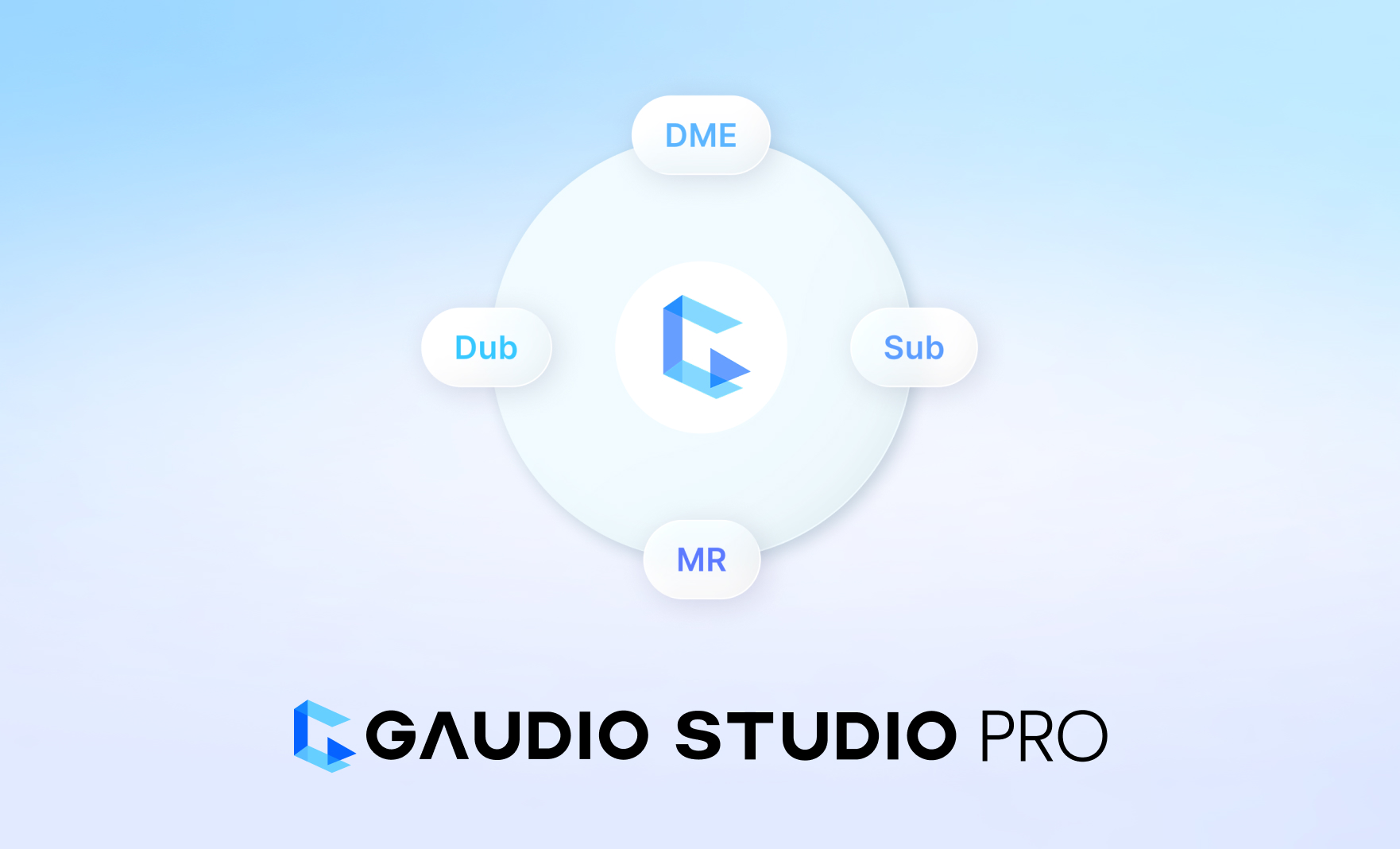
 

Gaudio Studio Pro


This is not just about working faster. It is about whether you can enter the global market ahead of the competition — whether you can launch simultaneously while a title is still generating buzz. It is about seizing the golden window of content localization.


In closing…


What we do is not simply converting text into sound. It is carrying the emotion, atmosphere, character dynamics, and genre density of the original work into another language.


And all of it is possible because AI and humans work together.


DME separation preserves the original audio without degradation. AI Voice Cast designs voices that fit both the character and the target audience. Emotion Mapping transfers the texture of emotion. HITL fills in the judgments AI cannot make. Content-specific pre-production sets the direction before work begins. And our collaboration with professional sound studio Wavelab delivers cinema-grade mastering.


All of these processes run on a single pipeline: Gaudio Studio Pro.


Experience-driven, content-specific dubbing. Gaudio Lab's full-stack AI dubbing delivers the experience of total immersion.
Contact Us


pre-image
How to Resolve Music Copyright Issues in Global OTT Distribution

How to Resolve Music Copyright Issues in Global OTT Distribution K-content exports and global distribution are growing at a rapid pace. Netflix, Disney+, Amazon Prime — simultaneous global releases of Korean dramas and variety shows have become commonplace. Yet in the day-to-day reality of international content distribution, "music copyright" issues frequently become a stumbling block.   This post explains why music copyright becomes a problem during content exports, how the industry has traditionally dealt with it, and how the AI-powered music replacement technology in Gaudio Lab's GSP (Gaudio Studio Pro) is changing the equation.       Why Music Copyright Becomes a Problem When Content Goes Global   Music copyright requires different licenses depending on region, usage type, and a range of other criteria. Even if a piece of music has already been cleared for domestic broadcast, a separate set of rights must be secured when that content is streamed on overseas OTT platforms. In other words, "domestic broadcast rights" and "international streaming rights" are entirely separate matters. Domestic terrestrial broadcast rights, domestic OTT distribution rights, and international streaming rights each fall under different contractual territories.   Here are some real-world examples of how music copyright issues play out in practice: A documentary production company tried to sell its content to an overseas OTT platform, but was unable to secure international streaming rights for the music used — and was forced to cut entire scenes as a result. A variety show exported to Taiwan saw royalty costs exceed its export revenue, creating a net loss on the deal. A YouTube creator used background music in a sports highlight reel, only to have Content ID automatically redirect 100% of the video's revenue to the original rights holder. These are not edge cases — they are challenges faced by a wide range of content producers and rights holders. As K-content exports continue to grow, music copyright clearing has become a mandatory step in every content pipeline.       What Global OTT Platforms Require   Global OTT platforms hold content to a high delivery standard. Rather than simply accepting a single finished video file, they typically require separate track deliveries: M&E (Music & Effects) or D/M/E (Dialogue/Music/Effects) splits, in which dialogue, music, and effects are delivered as distinct tracks. Why are split deliveries necessary? Multilingual dubbing: Only the dialogue track needs to be swapped out (original language → dubbed language), while music and effects are preserved. Music replacement: If a particular music track carries copyright issues, that track alone can be extracted and replaced. Local regulatory compliance: Different countries may require different music to be removed or replaced. In addition, platforms often require a Music Cue Sheet — a document listing every piece of music used in the content, including track titles, composers, publishers, timecodes, and usage types. Cue sheets serve as the basis for royalty accounting. In short, successful international delivery requires all of the following: Music copyright clearing or replacement D/M/E split tracks Music cue sheet   There is no shortage of hurdles to clear before a single drama or variety episode can be exported. Korean content comes with its own added complexity: music used in Korean productions is frequently licensed only for broadcast purposes, meaning all of it must be replaced before export. Given the time and cost involved, resolving music copyright issues has become one of the biggest friction points in K-content distribution.       How the Industry Has Traditionally Handled It   Three approaches have traditionally been used to address music copyright issues: Secure new international licenses: This means negotiating additional contracts for international streaming rights on a song-by-song basis. Theoretically the cleanest solution, but it requires individual negotiations for each track, makes cost forecasting nearly impossible, and can take weeks just to clear the rights for a single episode — which may feature upwards of 20+ songs. Delete the affected scenes: Simply cutting the scenes that contain unlicensed music. Fast, but it damages the integrity of the content. In scenes where music is integral to the storytelling, removing it can fundamentally alter the emotional impact and undermine the original creative intent. Manual music replacement by a sound engineer: A sound engineer separates the music from the original mix and manually replaces it with royalty-free tracks of a similar feel. This produces the best quality results, but a single 60-minute episode can take two to three weeks or more. For a drama airing two to three times per week, this approach is simply not feasible. All three methods share the same core problems: slow, expensive, and compromised quality. In a world where K-content is being delivered to global platforms on a weekly basis, these approaches run headlong into the speed demands of modern content distribution.       How AI-Powered Music Replacement Works   So how does AI-based music replacement actually work? The process unfolds in four stages. Stage 1: DME Separation — Isolating the Music AI automatically separates the original audio into Dialogue, Music, and Effects tracks. This step relies on GSEP (Gaudio Source SEParation), Gaudio Lab's proprietary technology and one of the highest-performing source separation systems in the world. The dialogue and effects tracks are preserved as-is, while the music track is extracted separately for replacement. The quality of the separation is everything here. If dialogue gets smeared or effects are lost in sections where dialogue and music overlap, even perfect music replacement cannot save the final output quality.     Stage 2: Music Identification — Mapping Every Track Individual songs are automatically identified within the separated music track. Even when a single 60-minute variety episode contains 100 or more songs, the system can extract a full music cue sheet — including start and end points and track metadata for every cue. The output is in an industry-standard format compatible with broadcasters, OTT platforms, and regulatory requirements worldwide. A music recognition API powers this stage and simultaneously feeds into automatic music cue sheet generation.   Stage 3: Similar Track Matching — Finding the Right Replacement For each identified track, the AI recommends replacement candidates with similar mood, genre, instrumentation, and energy level. Rather than simply matching by genre, the system converts music into multidimensional vectors and computes similarity scores — ensuring that recommendations stay true to the scene's context. For an article about the process by which AI finds similar music, please refer here.   Specifically, the following elements are compared: Genre and mood: Ballad, tension, comedic, and so on Instrumentation: Solo piano vs. full orchestra Tempo and energy: Original BPM and volume dynamics Structural progression: Intro → build → climax arc   GSP's premium library of over 110,000 tracks consists of high-quality, fully licensed music created by real musicians — not AI-generated content. This ensures the replacement music can genuinely honor the original creative intent.   Stage 4: Remixing — Blending It All Together When the replacement track is combined with the original dialogue and effects, the system preserves the volume envelope of the original music — ensuring the replacement follows the same dynamics. If the original music was a quiet underscore beneath dialogue, the replacement will match that same level. If the music swelled at a climactic moment, the replacement follows the same curve. This is called envelope preservation. After the final mix, a professional sound engineer reviews the output. It's a hybrid workflow: AI handles the heavy lifting quickly and accurately, while a human checks the final quality — ensuring a premium result every time.         How Much Faster Is It?   Introducing the AI pipeline dramatically compresses delivery timelines compared to manual workflows.     *Timelines may vary depending on content.   For a show airing two to three times a week, manual replacement simply cannot keep pace with the broadcast schedule. GSP's pipeline makes real-time delivery in sync with air dates a reality — compressing a process that once took roughly a month down to about three days.       Quality Matters Too   A replacement track will never be a perfect replica of the original. Directors and music supervisors make deliberate, intentional choices when selecting music for a scene, and no replacement can fully replicate those intentions. That said, what matters most in a practical content export workflow is not "identical reproduction" — it's "maintaining the viewing experience."   GSP takes the following factors into account as the core determinants of AI matching quality: Precision of segment boundaries: Accurately capturing the exact start and end of each cue. A misread boundary on a fade-in or fade-out creates jarring transitions. Preserving directorial intent: Evaluating mood and energy match with high fidelity. A comedic cue dropped into a tense scene collapses the emotional architecture of that moment. Seamless mixing: Ensuring the replacement track integrates naturally with the dialogue and effects tracks — not just swapping in a new song, but mirroring the original volume dynamics to eliminate any sense of artificiality.       Other Challenges in International Content Delivery   Music copyright is just one of several obstacles to clear for a successful international release. Full localization requires an integrated pipeline that encompasses music replacement and much more:         When all these stages are connected within a single platform, delivery timelines like "broadcast date + 3 days" become genuinely achievable. Splitting each stage across different vendors — re-explaining context each time, absorbing repeated revision loops — means the wait time between handoffs alone is enough to blow a delivery schedule.       Music Copyright Is the Bottleneck Holding Back K-Content's Global Reach   The creative strength of K-dramas and K-variety shows is beyond question. Global OTT platforms are actively acquiring Korean content and building dedicated K-content hubs within their platforms — demand continues to grow.   But no matter how good the content is, it cannot cross borders if music copyright issues remain unresolved. And as long as that process depends on manual workflows, the pace at which K-content can be delivered internationally is structurally constrained.   Music replacement through GSP is the key technology that breaks this bottleneck. By automating the full pipeline — DME separation → music identification → similar track matching → remixing — through AI, GSP makes "localized content delivery at broadcast speed" a reality.   Our mission is to keep pushing the boundaries of content export, so that a great piece of content can reach as many markets as possible and contribute to a more diverse revenue picture.   "Making great content is important. Making it possible for that content to cross borders is equally important."     Learn more about Gaudio Studio Pro · Contact us        

2026.03.09