How to Resolve Music Copyright Issues in Global OTT Distribution

2026.03.09ㆍ by Dewey Yoon

How to Resolve Music Copyright Issues in Global OTT Distribution

K-content exports and global distribution are growing at a rapid pace. Netflix, Disney+, Amazon Prime — simultaneous global releases of Korean dramas and variety shows have become commonplace. Yet in the day-to-day reality of international content distribution, "music copyright" issues frequently become a stumbling block.


This post explains why music copyright becomes a problem during content exports, how the industry has traditionally dealt with it, and how the AI-powered music replacement technology in Gaudio Lab's GSP (Gaudio Studio Pro) is changing the equation.


Music copyright requires different licenses depending on region, usage type, and a range of other criteria. Even if a piece of music has already been cleared for domestic broadcast, a separate set of rights must be secured when that content is streamed on overseas OTT platforms. In other words, "domestic broadcast rights" and "international streaming rights" are entirely separate matters. Domestic terrestrial broadcast rights, domestic OTT distribution rights, and international streaming rights each fall under different contractual territories.


Here are some real-world examples of how music copyright issues play out in practice:

  • A documentary production company tried to sell its content to an overseas OTT platform, but was unable to secure international streaming rights for the music used — and was forced to cut entire scenes as a result.

  • A variety show exported to Taiwan saw royalty costs exceed its export revenue, creating a net loss on the deal.

  • A YouTube creator used background music in a sports highlight reel, only to have Content ID automatically redirect 100% of the video's revenue to the original rights holder.

These are not edge cases — they are challenges faced by a wide range of content producers and rights holders. As K-content exports continue to grow, music copyright clearing has become a mandatory step in every content pipeline.


What Global OTT Platforms Require


Global OTT platforms hold content to a high delivery standard. Rather than simply accepting a single finished video file, they typically require separate track deliveries: M&E (Music & Effects) or D/M/E (Dialogue/Music/Effects) splits, in which dialogue, music, and effects are delivered as distinct tracks.

Why are split deliveries necessary?

  • Multilingual dubbing: Only the dialogue track needs to be swapped out (original language → dubbed language), while music and effects are preserved.

  • Music replacement: If a particular music track carries copyright issues, that track alone can be extracted and replaced.

  • Local regulatory compliance: Different countries may require different music to be removed or replaced.


In addition, platforms often require a Music Cue Sheet — a document listing every piece of music used in the content, including track titles, composers, publishers, timecodes, and usage types. Cue sheets serve as the basis for royalty accounting.

In short, successful international delivery requires all of the following:

  • Music copyright clearing or replacement

  • D/M/E split tracks

  • Music cue sheet


There is no shortage of hurdles to clear before a single drama or variety episode can be exported. Korean content comes with its own added complexity: music used in Korean productions is frequently licensed only for broadcast purposes, meaning all of it must be replaced before export. Given the time and cost involved, resolving music copyright issues has become one of the biggest friction points in K-content distribution.


How the Industry Has Traditionally Handled It


Three approaches have traditionally been used to address music copyright issues:

  1. Secure new international licenses: This means negotiating additional contracts for international streaming rights on a song-by-song basis. Theoretically the cleanest solution, but it requires individual negotiations for each track, makes cost forecasting nearly impossible, and can take weeks just to clear the rights for a single episode — which may feature upwards of 20+ songs.

  1. Delete the affected scenes: Simply cutting the scenes that contain unlicensed music. Fast, but it damages the integrity of the content. In scenes where music is integral to the storytelling, removing it can fundamentally alter the emotional impact and undermine the original creative intent.

  1. Manual music replacement by a sound engineer: A sound engineer separates the music from the original mix and manually replaces it with royalty-free tracks of a similar feel. This produces the best quality results, but a single 60-minute episode can take two to three weeks or more. For a drama airing two to three times per week, this approach is simply not feasible.

All three methods share the same core problems: slow, expensive, and compromised quality. In a world where K-content is being delivered to global platforms on a weekly basis, these approaches run headlong into the speed demands of modern content distribution.


How AI-Powered Music Replacement Works


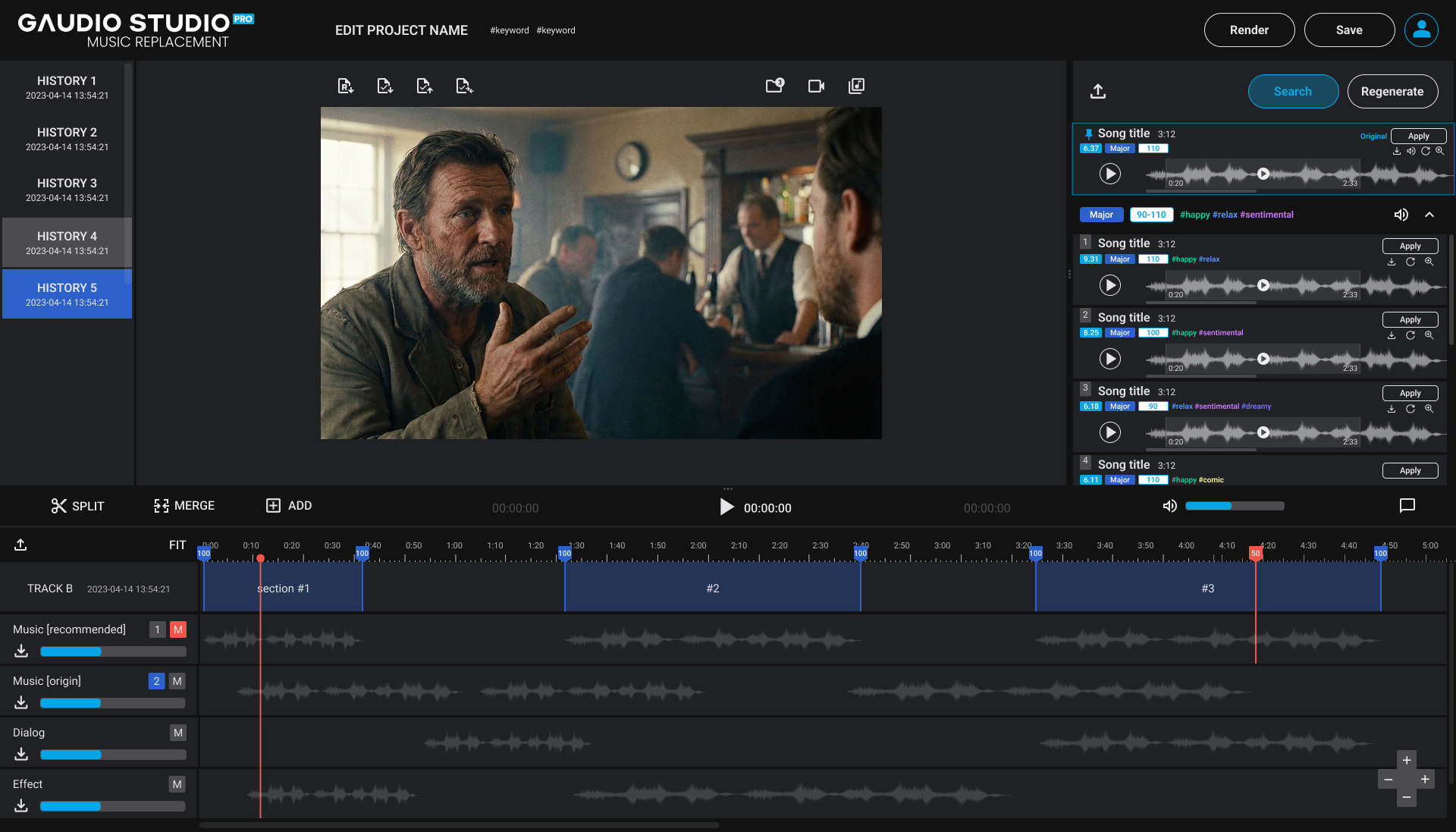
So how does AI-based music replacement actually work? The process unfolds in four stages.

Stage 1: DME Separation — Isolating the Music

AI automatically separates the original audio into Dialogue, Music, and Effects tracks. This step relies on GSEP (Gaudio Source SEParation), Gaudio Lab's proprietary technology and one of the highest-performing source separation systems in the world. The dialogue and effects tracks are preserved as-is, while the music track is extracted separately for replacement.

The quality of the separation is everything here. If dialogue gets smeared or effects are lost in sections where dialogue and music overlap, even perfect music replacement cannot save the final output quality.


Stage 2: Music Identification — Mapping Every Track

Individual songs are automatically identified within the separated music track. Even when a single 60-minute variety episode contains 100 or more songs, the system can extract a full music cue sheet — including start and end points and track metadata for every cue. The output is in an industry-standard format compatible with broadcasters, OTT platforms, and regulatory requirements worldwide. A music recognition API powers this stage and simultaneously feeds into automatic music cue sheet generation.


Stage 3: Similar Track Matching — Finding the Right Replacement

For each identified track, the AI recommends replacement candidates with similar mood, genre, instrumentation, and energy level. Rather than simply matching by genre, the system converts music into multidimensional vectors and computes similarity scores — ensuring that recommendations stay true to the scene's context. For an article about the process by which AI finds similar music, please refer here.


Specifically, the following elements are compared:

  • Genre and mood: Ballad, tension, comedic, and so on

  • Instrumentation: Solo piano vs. full orchestra

  • Tempo and energy: Original BPM and volume dynamics

  • Structural progression: Intro → build → climax arc


GSP's premium library of over 110,000 tracks consists of high-quality, fully licensed music created by real musicians — not AI-generated content. This ensures the replacement music can genuinely honor the original creative intent.


Stage 4: Remixing — Blending It All Together

When the replacement track is combined with the original dialogue and effects, the system preserves the volume envelope of the original music — ensuring the replacement follows the same dynamics. If the original music was a quiet underscore beneath dialogue, the replacement will match that same level. If the music swelled at a climactic moment, the replacement follows the same curve. This is called envelope preservation.

After the final mix, a professional sound engineer reviews the output. It's a hybrid workflow: AI handles the heavy lifting quickly and accurately, while a human checks the final quality — ensuring a premium result every time.


How Much Faster Is It?


Introducing the AI pipeline dramatically compresses delivery timelines compared to manual workflows.
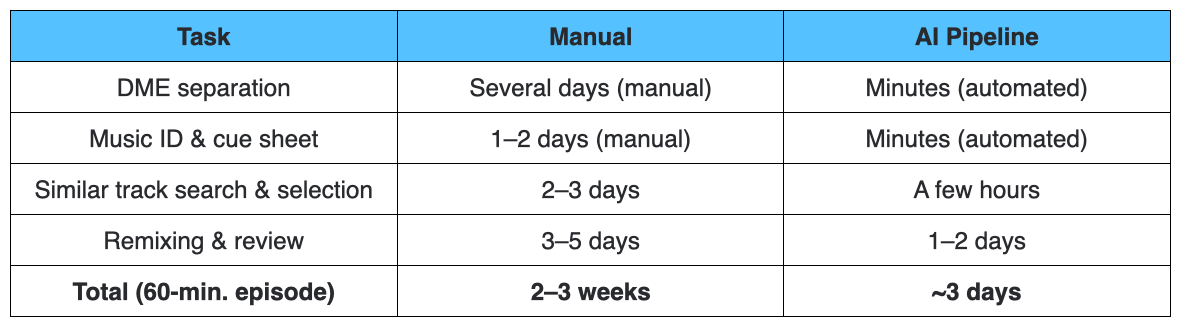


*Timelines may vary depending on content.


For a show airing two to three times a week, manual replacement simply cannot keep pace with the broadcast schedule. GSP's pipeline makes real-time delivery in sync with air dates a reality — compressing a process that once took roughly a month down to about three days.


Quality Matters Too


A replacement track will never be a perfect replica of the original. Directors and music supervisors make deliberate, intentional choices when selecting music for a scene, and no replacement can fully replicate those intentions. That said, what matters most in a practical content export workflow is not "identical reproduction" — it's "maintaining the viewing experience."


GSP takes the following factors into account as the core determinants of AI matching quality:

  • Precision of segment boundaries: Accurately capturing the exact start and end of each cue. A misread boundary on a fade-in or fade-out creates jarring transitions.

  • Preserving directorial intent: Evaluating mood and energy match with high fidelity. A comedic cue dropped into a tense scene collapses the emotional architecture of that moment.

  • Seamless mixing: Ensuring the replacement track integrates naturally with the dialogue and effects tracks — not just swapping in a new song, but mirroring the original volume dynamics to eliminate any sense of artificiality.


Other Challenges in International Content Delivery


Music copyright is just one of several obstacles to clear for a successful international release. Full localization requires an integrated pipeline that encompasses music replacement and much more:
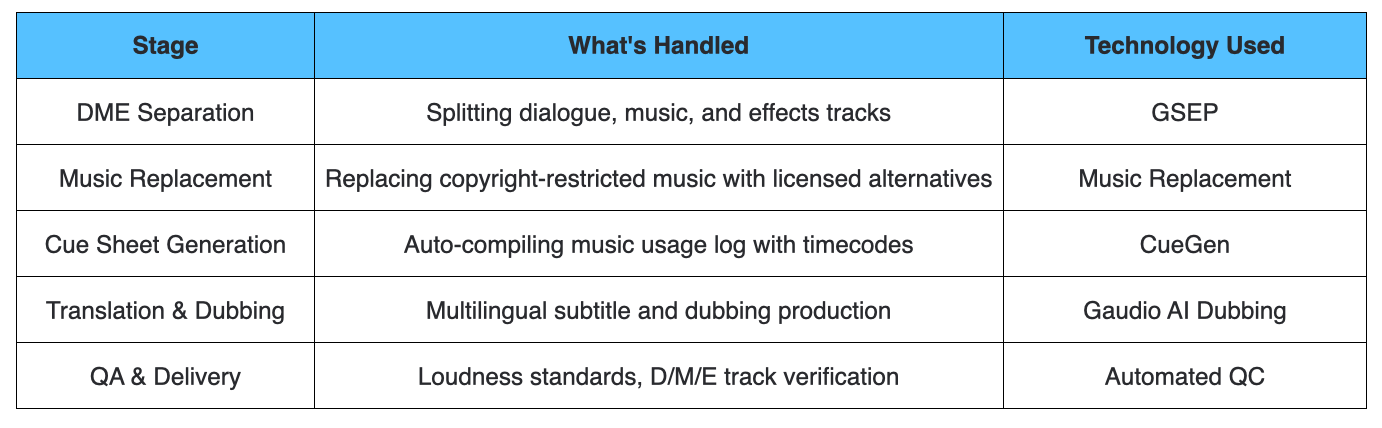


When all these stages are connected within a single platform, delivery timelines like "broadcast date + 3 days" become genuinely achievable. Splitting each stage across different vendors — re-explaining context each time, absorbing repeated revision loops — means the wait time between handoffs alone is enough to blow a delivery schedule.


The creative strength of K-dramas and K-variety shows is beyond question. Global OTT platforms are actively acquiring Korean content and building dedicated K-content hubs within their platforms — demand continues to grow.


But no matter how good the content is, it cannot cross borders if music copyright issues remain unresolved. And as long as that process depends on manual workflows, the pace at which K-content can be delivered internationally is structurally constrained.


Music replacement through GSP is the key technology that breaks this bottleneck. By automating the full pipeline — DME separation → music identification → similar track matching → remixing — through AI, GSP makes "localized content delivery at broadcast speed" a reality.


Our mission is to keep pushing the boundaries of content export, so that a great piece of content can reach as many markets as possible and contribute to a more diverse revenue picture.


"Making great content is important. Making it possible for that content to cross borders is equally important."


Learn more about Gaudio Studio Pro · Contact us


pre-image
Scaling Global Content with AI Translation: A Strategic Imperative

Scaling Global Content with AI Translation: A Strategic Imperative   AI Translation? Or Human Translation?   AI-powered translation is now widely used across industries. From draft translations designed to support high-quality output, to real-time chatbot-style translation, to tools optimized for specific use cases — AI is making it easier than ever to move across language barriers. In the process of global content distribution, AI translation is also being used strategically.   Today, we’d like to walk through some of the key considerations companies face when adopting or operating AI translation in their localization workflows.   Before we begin — Gaudio Lab’s AI localization process is built on advanced AI transcription technology. If you’re interested in that foundation, we recommend reading our related post.     In Global Content Localization, Translation Is… More than simply converting one language into another. It encompasses the comprehensive management of cultural context, quality, timelines, costs, and technical specifications — all at once.   As multilingual expansion accelerates across OTT platforms, broadcast media, esports, and educational content, the question of how translation is handled quickly becomes a business strategy decision.     The Most Frequently Asked Question During AI Adoption   Q. Why choose AI translation instead of traditional human translation?   Human-led translation generally offers strong quality and thoughtful cultural nuance. However, when projects scale — whether through larger content volumes or an increasing number of target languages — the following challenges often arise:   Delays in securing translator resources Greater difficulty coordinating schedules across languages Rising communication overhead Increased lead times due to repeated review and revision cycles   For example, imagine exporting content produced in Chinese to Brazil, a Portuguese-speaking market. [In many cases, the translation process becomes: Chinese → English → Portuguese]   This requires multiple translators across different languages. And as mentioned earlier, translation must account not only for language, but also regional characteristics and cultural nuance. Securing specialized professionals at the right time and coordinating schedules often requires more time and cost than anticipated.   As these bottlenecks accumulate, lead times extend — increasing the risk of missing the golden window for content distribution. For projects with fixed schedules — such as OTT delivery deadlines, campaign launches, or live esports broadcasts — delays can become critical. In these situations, proactively adopting AI translation can be a strategically sound choice.     Q. What changes when AI translation is introduced?   The biggest differences lie in speed and cost structure. When AI translation is implemented, organizations can expect: Dramatic reductions in per-unit cost Translation speed improvements of up to 100x at the draft stage The ability to handle urgent projects without rush fees or time limitations   Beyond these advantages, Gaudio Lab’s AI translation workflow is designed to reduce inefficient rework loops while maintaining high consistency and quality. GSP has built logic into the draft generation stage that detects and corrects common issues, such as: Mistranslations caused by insufficient cultural awareness Low-quality literal translations that fail to preserve character context Awkward phrasing that loses the title’s cultural background   By carefully structuring the translation process in this way, we shorten repeated revision cycles, reduce translator workload, and maintain high levels of consistency and quality.   In short, Gaudio Lab’s AI translation is specifically structured for global content distribution: Fast draft generation → Short, efficient review cycles → On-time release within the golden window   This structure minimizes inefficiencies across the translation process while maintaining speed.   Q. Where does the ROI of AI translation actually come from?   The benefits of AI translation extend beyond cost savings.   With AI translation: You can cover more projects or titles within the same budget. Expansion into additional languages becomes more feasible. The tighter the schedule, the greater the cost-efficiency impact. Internal scheduling and workforce management burdens are reduced, lowering operational risk.   For content launching simultaneously in multiple languages, AI translation offers a particularly strong advantage.     What About Gaudio Lab’s AI Translation Solution?   There are many translation and transcription solutions currently active in the market — AI-driven localization startups, translation-focused SaaS platforms, and traditional global studios that operate large translator pools.   Q. So what differentiates Gaudio Lab’s translation solution?   Despite being fast and cost-efficient, many AI translation tools on the market create downstream issues that lead to: Revision → Re-review → Re-recording loops. And ultimately, delays in content distribution.   Common examples include: Incorrect translations due to contextual or cultural sensing errors Stylistic inconsistencies that break tone Violations of age-rating or content guidelines Dialogue length mismatches that create discomfort during viewing   Gaudio Lab addresses these issues in the following ways:   Drawing on extensive localization experience, we have embedded solutions for common pain points in dubbing and subtitle workflows. We operate with structured review and approval standards to minimize rejection during the approval process. We utilize specialized translation technology designed for AI dubbing, including: Automatic syllable-per-second calculation Dialogue length alignment Lip-sync vowel pattern similarity analysis Speech rhythm recognition     In other words, we move quickly with AI translation while building differentiation at key review checkpoints — minimizing the costly “revision → re-review” loop that threatens distribution timelines.   GSP also separates subtitle translation and dubbing translation based on purpose.   Subtitle translation prioritizes readability and clarity of information. Dubbing translation prioritizes dialogue that can be naturally performed. Many translation workflows generate outputs in the same tone regardless of purpose, which leads to additional revisions later. Gaudio Lab designs translation direction differently depending on whether the output is intended for subtitles or dubbing — resulting in higher suitability in real-world localization workflows.   For example, in children’s educational programs, dialogue often relies on repetition and rhythmic, song-like phrasing to support engagement and comprehension. Because of this, subtitle translation and dubbing translation are intentionally created differently to reflect their distinct purposes.   If we take the Japanese line “シャキシャキの葉っぱです。” (literally, “We are crispy, crunchy leaves!”) and translate it into English, the outputs would be structured as follows:   [Subtitles] “We are crispy and crunchy leafy vegetables.” (Prioritizes clarity, readability, and accurate information delivery.)   [Dubbing] “Crispy crunchy leaves — that’s us!” (Designed for natural performance, easy pronunciation, and a lively rhythm suitable for voice acting.)     Q. Is context-aware AI translation possible?   Yes. And context-based translation — reflecting speaker, listener, and intent — is a critical component of the AI translation process. Without contextual information, errors in tone, formality, or emotional nuance can disrupt audience immersion and require duplicated effort from production teams.   This is particularly common when translating from high-context languages to low-context languages, resulting in issues such as:   Incorrect formality levels Character voice inconsistency Emotional distortion     For example, generic AI systems often default to masculine pronouns when gender is unknown.   If someone asks in a language other than English, “Did that (female) person eat?” A basic AI system may output: “Did he eat?”   Gaudio Lab builds character-level databases that include gender, age, speech style, and character relationships. By incorporating scene context, speaker information, and emotional flow, we control and optimize expression accordingly — preventing such errors.   In serialized content, maintaining consistent tone — including speech style, naming conventions, and terminology — is especially important. Our character library approach ensures continuity across episodes. We also account for spoken length and breathing patterns to minimize re-recording while preserving translation quality. Q. We experienced frequent rejections due to age ratings or platform guidelines with other translation solutions. How does Gaudio Lab address this?   Even natural-sounding translation can be rejected if it violates established guidelines. When translation relies heavily on individual translator intuition, inconsistency becomes more likely — especially as project scale increases.   Gaudio Lab establishes structured translation standards, including: Prohibited terms Alternative phrasing rules Euphemistic substitutions Platform-specific language guidelines   By applying pre-configured project guidelines at the system level, we proactively prevent errors before they occur. Clear project guidelines are automatically reflected and reviewed during the translation stage.   As a result: Rework rates decrease Accuracy improves Production speed increases   The larger the project, the more critical structured control becomes.   We use precisely designed AI at multiple points in the translation workflow based on project requirements — enhancing both quality and accuracy.     Translation Is Not Just About Speed — It’s About Structure and Strategy   AI translation is not simply a cheaper, faster tool. It is a structural solution to: Lead-time management Rework loops Quality standards Delivery risk   Gaudio Lab’s AI translation workflow combines:   AI generation + controlled standards + dubbing-oriented optimization + automated review   The goal is to protect the golden window of content distribution while maintaining studio-level quality. Supporting our clients’ global content expansion without compromising quality — that is the core purpose of Gaudio’s GSP translation process.     👉 Contact us 👉 Experience GSP firsthand    

2026.02.25