From LKFS to true peak, the complete guide to Loudness

What exactly is loudness?
Loudness refers to the perceived amplitude of a sound as interpreted by human hearing. Imagine you want to tell someone about the volume of the song you're currently listening to. If the sound is loud, you'd say its loudness is high; if it's quiet, its loudness is low. However, there's no guarantee that another person will perceive loudness in the same way you do. This assurance diminishes as the number of people increases. In such cases, the most efficient method is to convey the sound's intensity using an objective, numerical metric or unit. Given the widespread need across various fields, research into loudness units has been very active. Here, we'll introduce a unit that is commonly used and highly practical in markets like broadcasting and streaming.
The unit we'll discuss is LKFS (Loudness K-Weighted relative to Full Scale), also known as LUFS (Loudness Unit relative to Full Scale). The parameters associated with this unit were developed by the ITU-R (International Telecommunication Union – Radiocommunication) and the EBU-R (European Broadcasting Union).
What factors are primarily considered when measuring loudness?
When measuring loudness, several key parameters are commonly used. If you examine the loudness meters provided in various measurement tools or Digital Audio Workstations (DAWs), you'll generally find that they include essential items such as Integrated, Short-Term, and Momentary loudness, True Peak, and Loudness Range. In this chapter, we will delve into the meaning of each of these parameters.
2-1. Key Keywords: LKFS, LU, Momentary Loudness, Short-term Loudness, Integrated Loudness, LRA, True-peak
- LKFS (Loudness K-Weighted relative to Full Scale) a.k.a. LUFS (Loudness Unit relative to Full Scale)
This is one of the units for loudness. It represents the amplitude of an input signal that has passed through a K-weighting filter, which is designed to align with human hearing characteristics. You can understand the K-weighting filter as one that increases signals in frequency ranges that humans hear relatively well, and decreases signals in frequency ranges that are relatively less audible. Loudness can be categorized into Momentary, Short-term, and Integrated Loudness based on the duration over which it is measured. Momentary Loudness refers to the sound level over a 0.4-second window, Short-term Loudness over a 3-second window, and Integrated Loudness represents the overall sound level across the entire duration.
*What are LKFS and LUFS, and what is the difference between them?
The unit for loudness was initially conceived by the ITU (International Telecommunication Union), which defined the unit as LKFS (Loudness K-Weighted relative to Full Scale). Subsequently, the EBU (European Broadcasting Union) devised the display methods and defined terms such as Momentary, Short-term, and Integrated Loudness, along with Loudness Range (LRA), and then changed the designation to LUFS (Loudness Unit relative to Full Scale). Consequently, there is a tendency for LKFS to be used in North America, while LUFS is more prevalent in Europe.
-
LU(Loudness Unit)
While LKFS represents an absolute measured value, LU (Loudness Unit) is a relative measurement. It is used to express the difference from a reference level or to describe the range of loudness. For example, if Content A is at -12 LKFS and Content B is at -20 LKFS, one could state, "Content A sounds 8 LU louder than Content B."
-
Momentary Loudness
Momentary Loudness is the sound level corresponding to a 0.4-second segment of the signal after it has passed through a K-weighting filter. It is measured with a 75% overlap (0.1 seconds). This can be understood as the instantaneous sound level.

When the measurement results, as shown in the image above, are accumulated into a histogram, the result is as depicted in the image below.
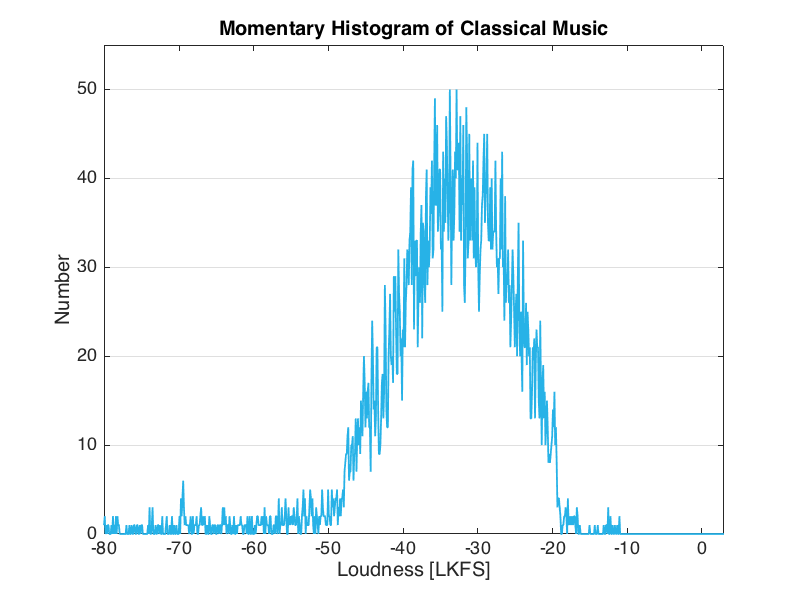
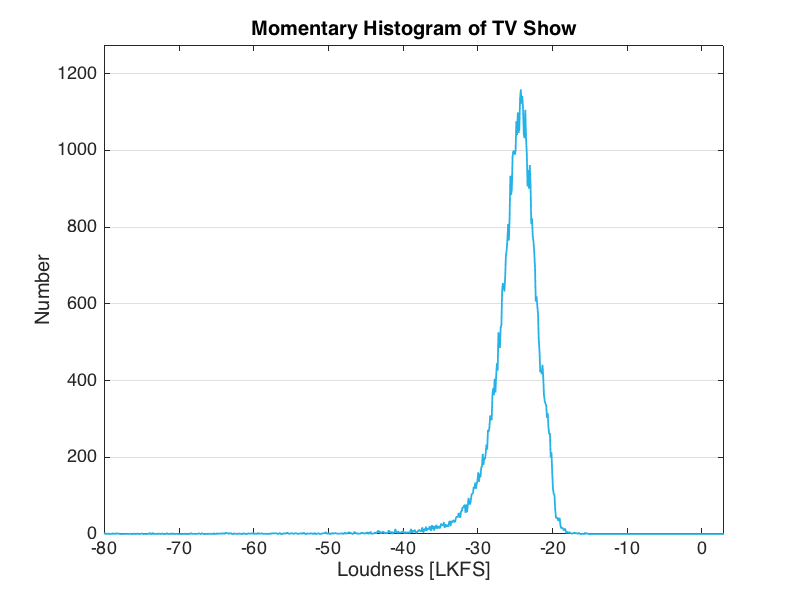
The histogram of Momentary Loudness is subsequently used in the calculation of Integrated Loudness.
- Short-term Loudness
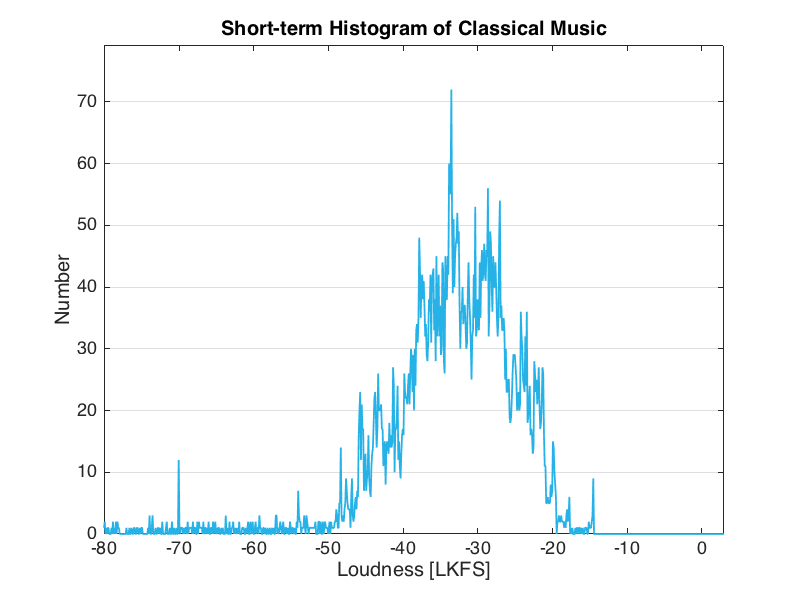
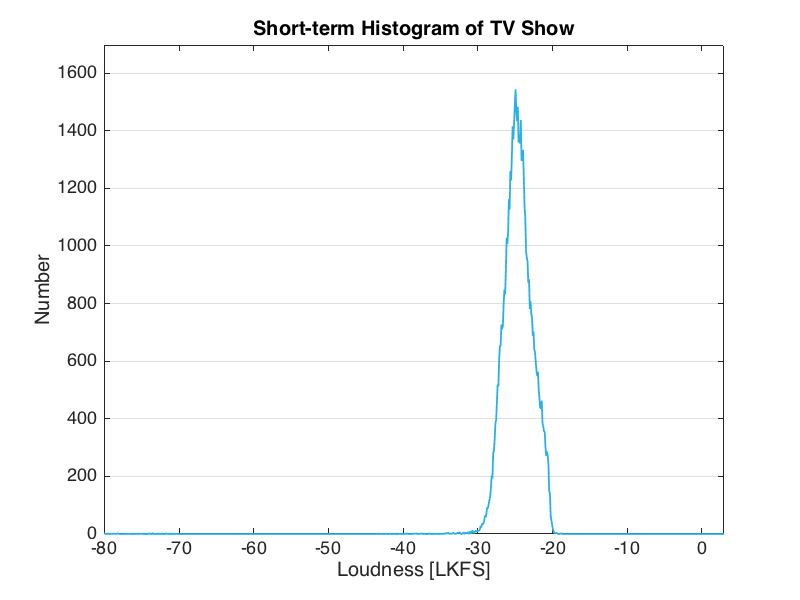
Short-term Loudness refers to the sound level corresponding to a 3-second segment of the signal after it has passed through a K-weighting filter. The EBU recommends that this value be updated at a minimum interval of 0.1 seconds.


-
Integrated Loudness
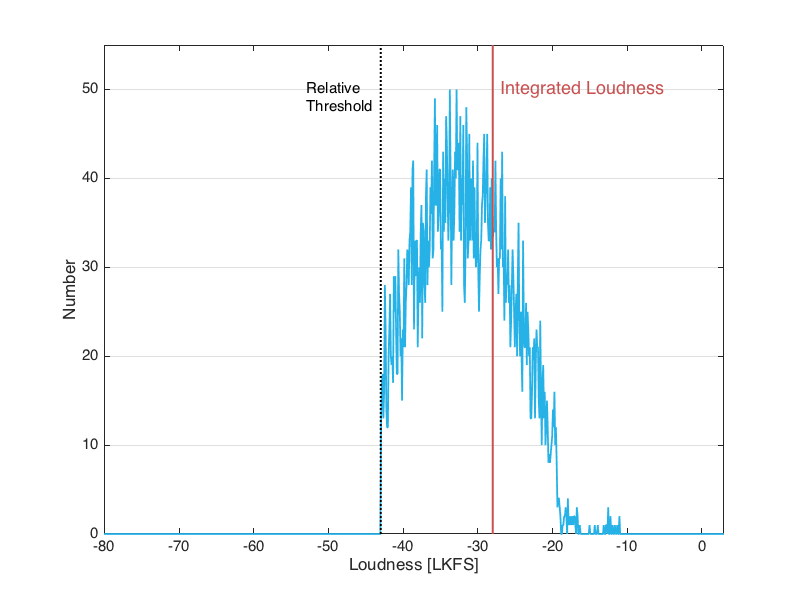
Integrated Loudness is the average sound level perceived across the entire duration of a piece of content. It represents the overall loudness of the content. The calculation method is as follows:
Step 1) Remove the momentary loudness distribution values below -70 LKFS, then calculate the average of the remaining distribution values.
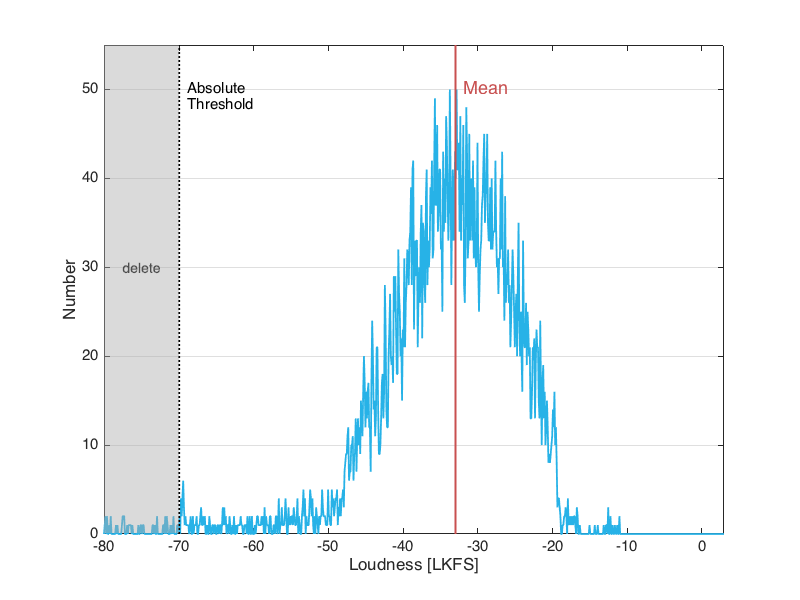
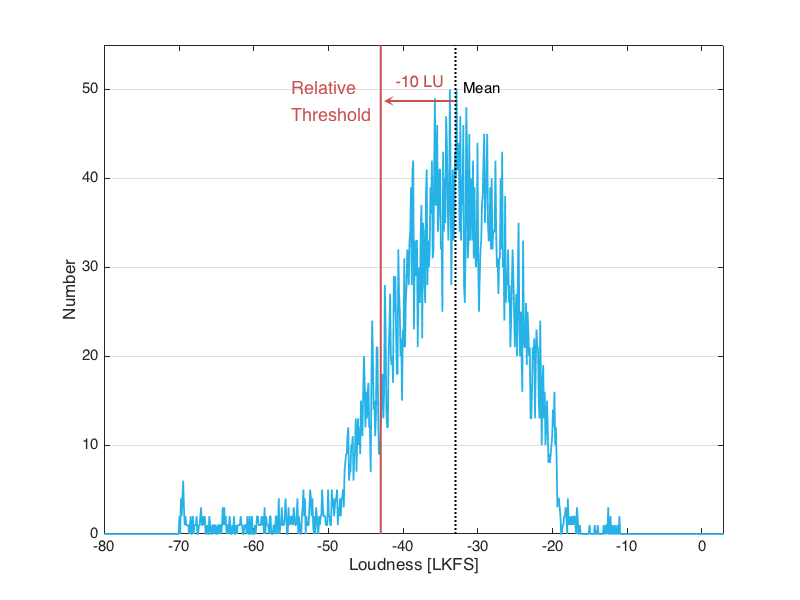
Step 3) The average of the distribution values that are above the relative threshold is the Integrated Loudness.

-
LRA(Loudness Range)
LRA (Loudness Range) is a metric that indicates the variation in loudness over time within a single piece of content. It serves as an indicator of how widely the sound levels are distributed. The calculation method is as follows:
Step 1) Remove the short-term loudness distribution values below -70 LKFS, then calculate a value that is 20 LU less than the average of the remaining distribution values (this is the relative threshold).
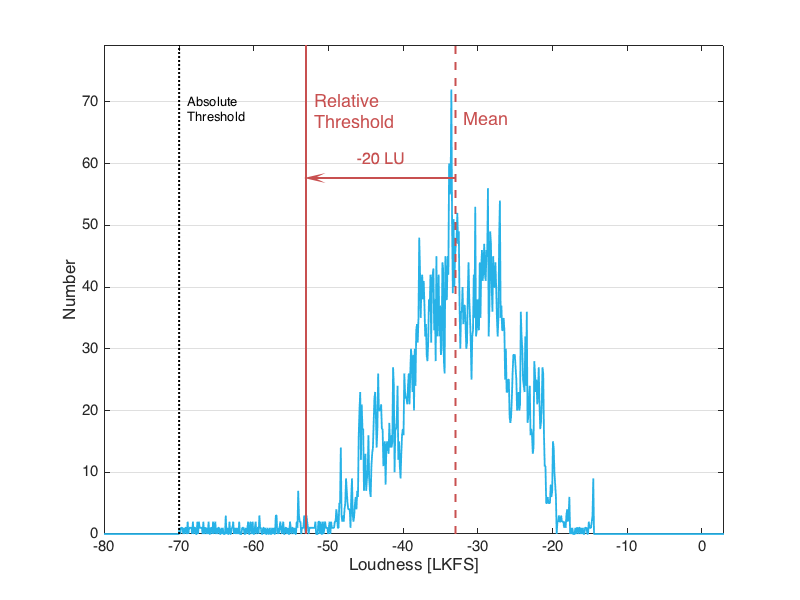
Step 2) The difference between the top 5% of the distribution values and the bottom 10% of the distribution values that are above the relative threshold is the Loudness Range.
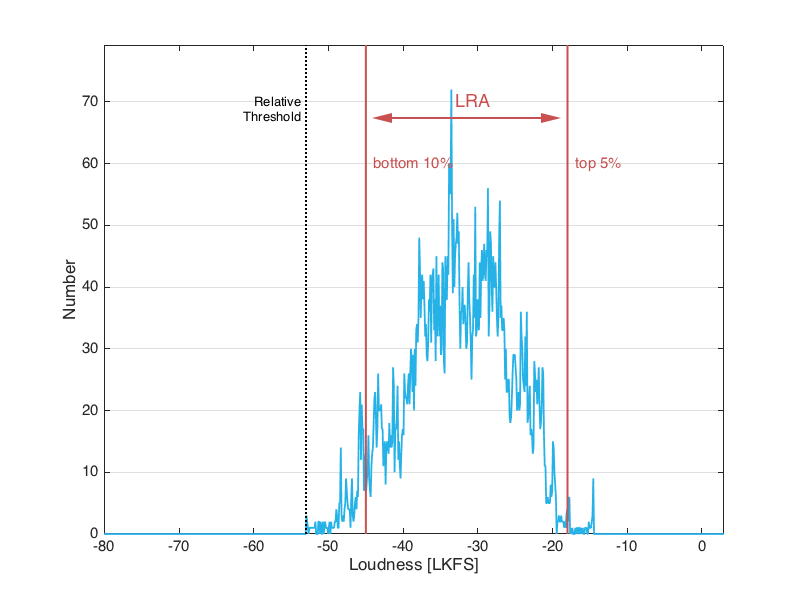

*In both Integrated Loudness (IL) and Loudness Range (LRA) calculations, the concept of a Relative Threshold is used, but their definitions differ. For IL calculations, momentary loudness is utilized, and the relative threshold is defined as the average of the values above the absolute threshold minus 10 LU. Conversely, for LRA calculations, short-term loudness is used, and the relative threshold is defined as the average of the values above the absolute threshold minus 20 LU.
-
True-peak
True-peak refers to the peak value when a signal is converted to a 192 kHz sampling frequency, and its unit is dBTP. This value can be understood as a measure to prevent degradation in playback environments, particularly when using sufficiently high sampling frequencies (like 192 kHz). Since audio commonly consumed usually has sampling frequencies of 44.1 kHz or 48 kHz, upsampling is a common process. During this upsampling, the peak value can sometimes exceed the original sample peak value. An example of upsampling is provided below.

In addition to the core upsampling technique, other processes are undertaken to prevent the signal from exceeding its representable range (attenuation), to retain only valid signals after upsampling (filtering), and to convert values to the decibel scale (logarithmization). The block diagram below illustrates the series of steps involved in calculating the true-peak when the sampling frequency is 48 kHz.


2-2. Getting to know loudness

Why are LKFS (LUFS) used instead of the traditional RMS?
Previously, RMS (Root-Mean-Square) was used to measure loudness, but it did not align well with actual human auditory perception. Subsequently, the ITU and EBU developed a more sophisticated method for calculating loudness by incorporating a K-weighting filter to reflect human hearing capabilities. As seen in the loudness calculation process, this method also excludes parts that have no influence on the perception of sound pressure. It is likely that this more refined approach, compared to other units, has led to its widespread adoption.
What is the 'Loudness War' and why is it a problem?
I'd like to discuss an issue related to loudness that many of you might already be familiar with: the 'Loudness War.' To summarize it in my own words, it's when content creators produce content with the mindset of, "By making my creation louder than others, I will grab more attention from listeners. As a bonus, it might even trick listeners into thinking the sound quality is better." Alternatively, it could also be a mindset of, "While I won't make my creation significantly louder than others, I'll ensure there isn't a large difference."
While a louder sound might lead one to believe the sound quality has improved, in reality, the dynamic range narrows, reducing expressiveness, and the frequency of clipping increases, raising the probability of sound quality degradation. I hope that many consumers will recognize that excessively increasing loudness actually diminishes the quality of the audio itself, and that their consumption patterns will change accordingly.

Loudness Regulations and Recommendations for Streaming Platforms (masteringthemix)
Hopefully, your questions about loudness have been answered!
This post is a translated version of 'Loudness 101 (KR)', originally published in 2019.
If you're looking for more in-depth or specialized information, we highly recommend consulting the following international standard documents, which contain detailed technical information on loudness measurement and regulation:
-
ITU-R BS.1770-4: provides the standard for loudness measurement algorithms.
-
EBU-R Tech 3341, 3342: offers detailed guidelines on loudness regulation and measurement methods in broadcasting environments.
If you have any further questions about loudness or Gaudio Lab's loudness technologies, please feel free to contact us!
Would you like to know more about loudness?
Loudness Management: How audio technology will impact streaming video


Our audio technologies support various devices and platforms.