Meet the Top AI Source Separator, Gaudio Studio as a Mobile Application

2025.07.04ㆍ by Gaudio Lab


Gaudio Studio App Release


Separate sounds in your videos and music with just a tap.


The Gaudio Studio app is finally here.

Have you ever wanted to separate a specific sound while practicing an instrument or watching a video you filmed yourself?


“If only I could extract just the piano...”

“If only I could hear the voice clearly, without all that background noise...”


All of that was already possible with the web version of Gaudio Studio — and now, it’s available as a mobile app. Experience our powerful AI source separation technology more conveniently, more intuitively, and more freely, right from your phone.


What makes the Gaudio Studio App different?


The answer is simple: GSEP, short for Gaudio source SEParation.

It is Gaudio Lab’s proprietary AI model — one of the most advanced in the world. Thanks to GSEP, Gaudio Studio has been ranked No. 1 by Musicradar, MusicTech, and LANDR.


With this technology, you can upload an audio file and precisely separate it into individual stems — such as vocal, the drum, the bass, and the guitar — allowing for creative editing and custom combinations. And, by uploading a video, you can cleanly separate the voice from background noise, which is one of the exclusive features.


 We made it easier - for our web users


“I like the web version, but using it on my phone feels a bit inconvenient…”

That was the most common feedback we received from users accessing Gaudio Studio on mobile.


While many users recognized the quality of our AI sound separation on the web, using it on a smartphone browser just wasn’t ideal. It required repeated logins, reconnecting through the browser, and navigating a small screen with too many steps. While users were satisfied with the performance, the overall experience wasn’t smooth, leading many to use it once or twice and then give up.


We couldn’t stand to see our valued users struggle with inconvenience. And, that’s why we launched the app.
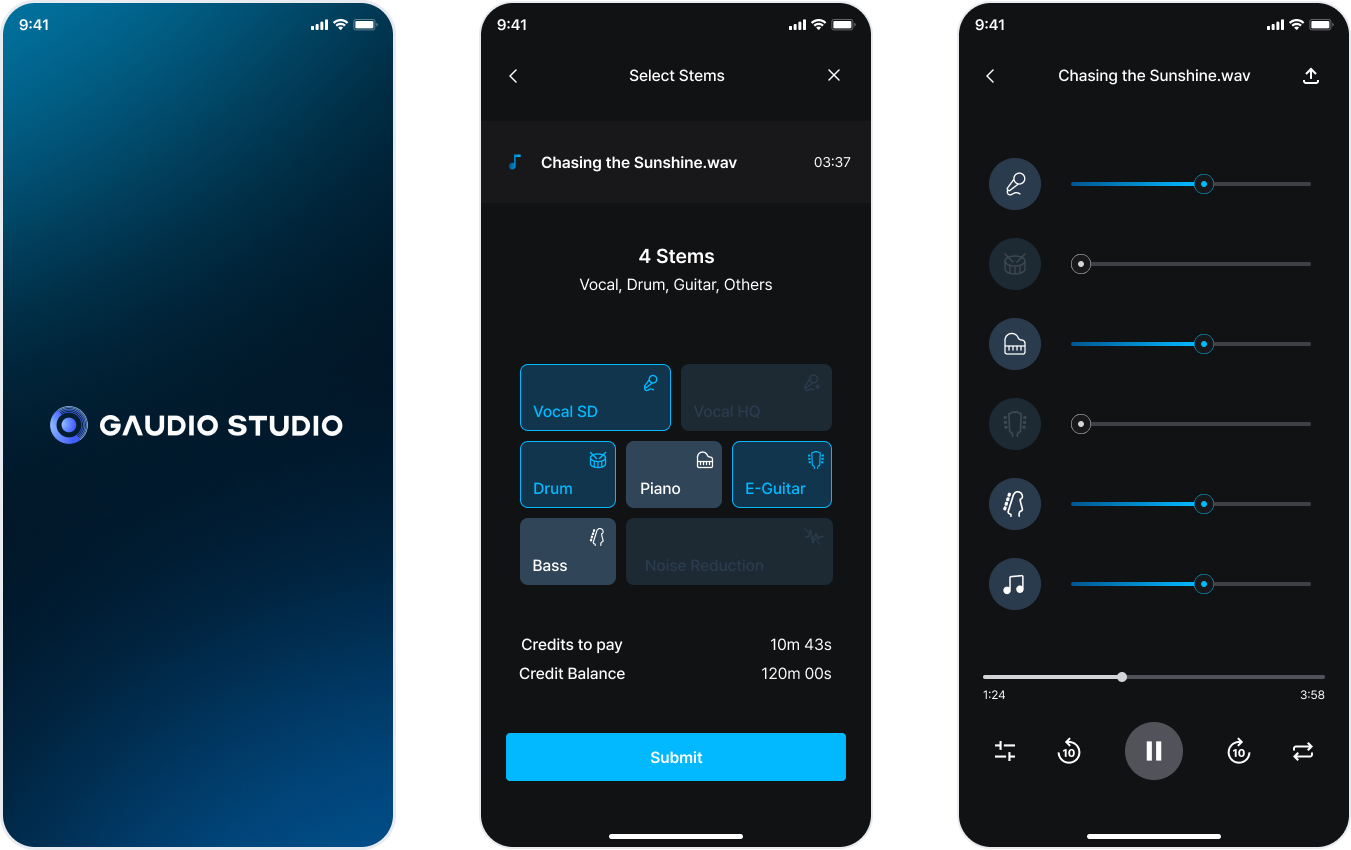


Gaudio Studio App


Web vs. Mobile, what's different?


Lighter, simpler, more accessible. That’s what the app is all about.

Our mission with the app was to keep the powerful features of the web version — including GSEP-based source separation and noise reduction — while reimagining the experience for mobile with more intuitive UX. For instance, it's now much simpler to upload videos shot on your phone and remove background noise instantly.


Whether you’re a professional musician, a music major, or just someone who loves experimenting with audio, Gaudio Studio gives you studio-level control from anywhere: in bed, at a café, or on the subway — all with just a few taps. We believe professional tools shouldn’t require professional skills. That’s why we designed a touch-friendly, intuitive interface that lowers the barrier to entry and lets anyone enjoy the full power of AI sound editing.


And that’s not all — the mobile app goes even further.


Even more features: Pitch, Tempo, and Loop Control

We’ve also added features that weren’t available in the web version, such as pitch shifting, tempo adjustment, and looped playback. These were some of the most requested functions from our web users. Now, you can repeat specific sections or slow them down to practice vocals or instruments with greater precision.


The first goal of the app is to help the web users use Gaudio Studio more conveniently. And of course, we’re just as excited to welcome new users discovering us for the first time through the app!
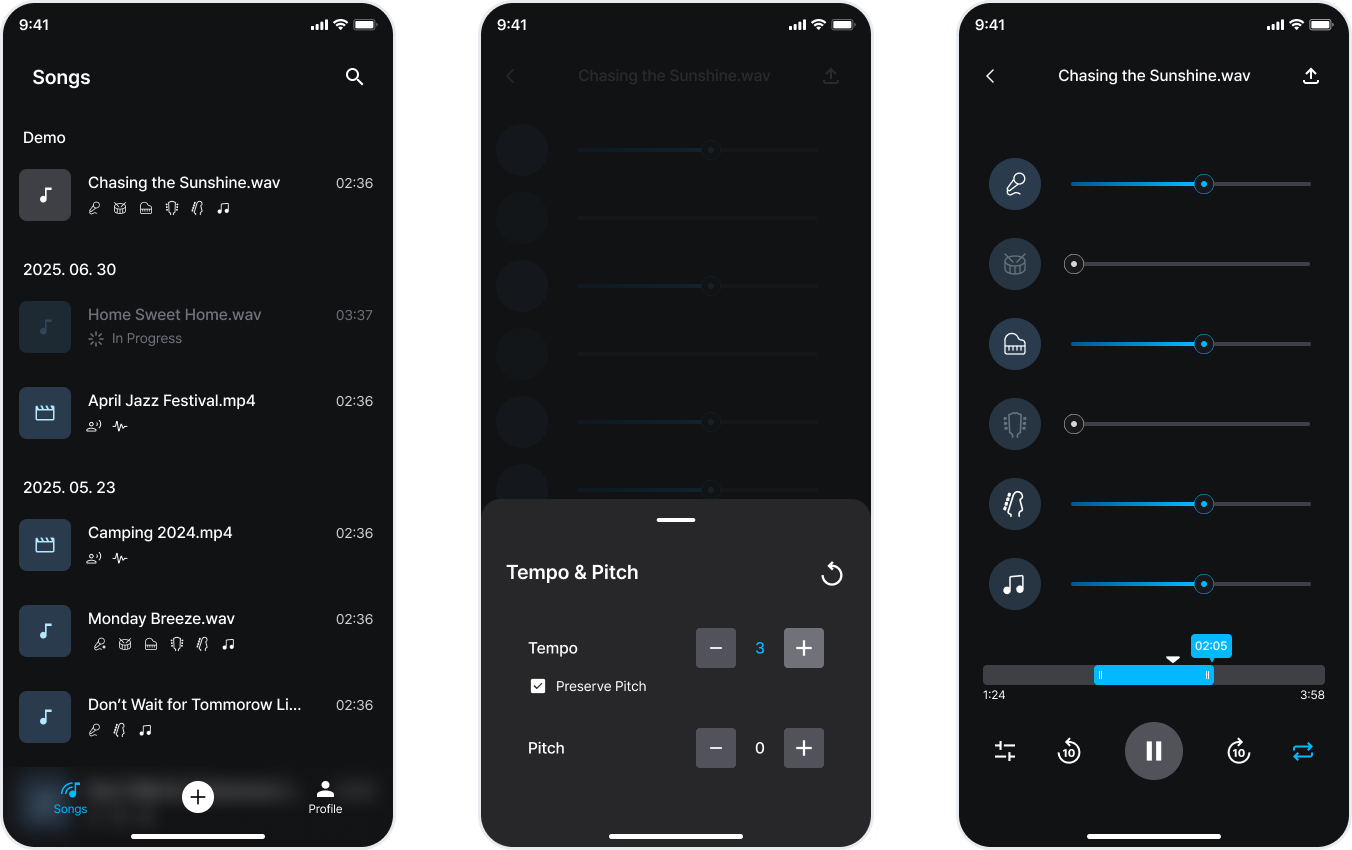


Gaudio Studio App


Curious about what’s next?


Following the app launch, we are closely monitoring how people use the app: Are they finding it convenient? Are they having more fun creating and practicing music? These insights will help us improve features and polish the experience. So, your feedback truly shapes what comes next!


We'll always keep our ears open and be ready to hear your valuable feedback first, and up close.


Our mission at Gaudio Lab is simple.


We provide an excellent sound experience through innovative technologies.

The Gaudio Studio App is an extension of that mission. It’s a tool that helps anyone edit, remix, and enjoy music and audio — anytime, anywhere. And above all, it’s designed to make that process easy and enjoyable. We’ve built this app with care and conviction.


Now we invite you to try it for yourself — available now on the App Store and Google Play.


Here’s to your creativity and your love of sound — with more freedom, and more fun. 🎧


Would you like to know more about Gaudio Studio?

GAUDIO STUDIO Source Separation Tips - A Sound Engineer's Guide 

Everything about Gaudio Studio 

Visit Gaudio Studio


pre-image
How AI agents help Gaudio Lab's SDK team work smarter

    Did you enjoy Part 1 of the GDK Development Team interview? In this article, we’ll dive deeper into how they approach and solve problems with AI Agent.   If you haven’t read Part 1 of the GDK Development Team’s story yet, click here!       Even small changes deserve careful verification   Q: With such a range of work, what challenges have you faced—and how did you overcome them?   Leo: One recurring challenge is communicating when we port our SDK to third-party platforms. Especially with closed platforms or third-party chips, it’s often hard to obtain the necessary information. And when teams are physically far apart, inefficient communication loop can become a real issue. For example, confirming how a piece of hardware behaves can take days—or even up to a month.   To work around this, we assume the other side can’t see our setup and try to communicate as clearly and kindly as possible, providing thorough context. That’s why communication skills—being able to clarify complex situations—are just as important as technical skills.   Another challenge is that audio is difficult to evaluate quantitatively. Because sound quality is often judged subjectively, even minor code changes can affect the listener’s perception. That’s why we consult our in-house audio experts—yes, we have nine PhDs in acoustics!   One of our core philosophies is: “Even small changes deserve careful verification.”   William: One challenge I remember is from one of the Sound Quality projects. Each client had slightly different expectations for how the SDK should behave. As a result, even a single version could become fragmented, creating overhead in managing and automating deployments.   Ideally, we’d provide one well-built SDK to all clients, but realistically, customization is often unavoidable depending on the client’s priorities. We constantly walk a fine line between standardization and customization—and I think managing that balance is one of our key strengths.       Embracing AI Agents—Tools that truly boost productivity   Q: I heard your team started to use AI Agents in development. What kind of changes do you expect?   Leo: We’re still in the early stages—exploring which tools to use and how to integrate them into our process. We had been using some tools already, but what really kicked things off was a seminar by our frontend developer, Handy. After that, the team became aligned on experimenting more seriously. And once we started, the benefits became clear.   William: We’re still figuring things out, but our productivity has definitely improved. We try to delegate repetitive tasks to AI so we can focus on core logic. I’ve found that if I define the task clearly—like in a commit-sized chunk—the AI can produce really useful results. We then review and refactor the output. For repetitive or boilerplate code, AI completes tasks in seconds. We’re seeing clear potential for time savings and efficiency.   Leo: AI Agents significantly lower the initial barrier when starting a new, unfamiliar project. They’re also great at reducing human errors that are easy to overlook, and they serve as helpful collaborators during code reviews. I’m really optimistic about their potential.     Q: It sounds like your team is open to new tech!   William: Definitely. If a tool can improve efficiency, we’re willing to try it. Especially in areas with fewer external dependencies—like demos, test tools, or CLI utilities—we’re encouraged to experiment. Of course, SDK development requires more caution due to stability and compatibility concerns. But, if a tool proves to be effective, we are open to adopting it.             We welcome proactive, respectful teammates    Q: People say Gaudio Lab’s biggest asset is its people. What are your teammates like?   William: Most of us are introverts—except maybe Jayden (laughs). I’m the youngest on the team, and compared to my friends’ workplaces, ours has no pressure from seniority. It’s a very relaxed and comfortable environment. I’ve never had issues with team dynamics.   Leo: I agree. We all have different personalities, but when it comes to work, we express ourselves clearly and respectfully. We communicate smoothly, without unnecessary conflict. Our team lead, Seo, emphasizes ownership—encouraging each member to take initiative and lead their work. It’s created a culture where we naturally take responsibility, and if you want to try something, you’re encouraged to speak up and go for it.       Final message to future teammates of Gaudio Lab SDK   Leo: The most important quality is adaptability—the ability to embrace change and new environments. If you’re proactive and curious, you’ll do well here. From a teamwork perspective, we look for people who can collaborate respectfully and share ideas harmoniously. Since many of our projects are fast-paced, it’s a great fit if you enjoy working with quick, dynamic rhythms.   William: I’d recommend this team to anyone who wants diverse experience. We frequently take on new challenges, so, it’s great for people who are open to change. And if you’re interested in music or audio, this is the perfect place to turn your ideas—like “It’d be cool if an SDK did this”—into reality. If you enjoy your work like a hobby rather than just a job, this team will be a fantastic fit.       Curious about the products developed by the GDK team at Gaudio Lab? 🔊 LM1 – Loudness normalization solution 🌐 Gaudio Spatial Audio – Spatial audio solution 🔇 Just Voice – AI-powered noise reduction solution   In addition to these, the GDK team has also contributed to many other products such as: ELEQ (Loudness EQ), Smart EQ (Smart Equalizer), Binaural Speaker (3D Audio Renderer), and GFX (Audio Effects Library).       If you found the story of the GDK development team intriguing, Explore Life at Gaudio Lab:)              

2025.06.27
after-image
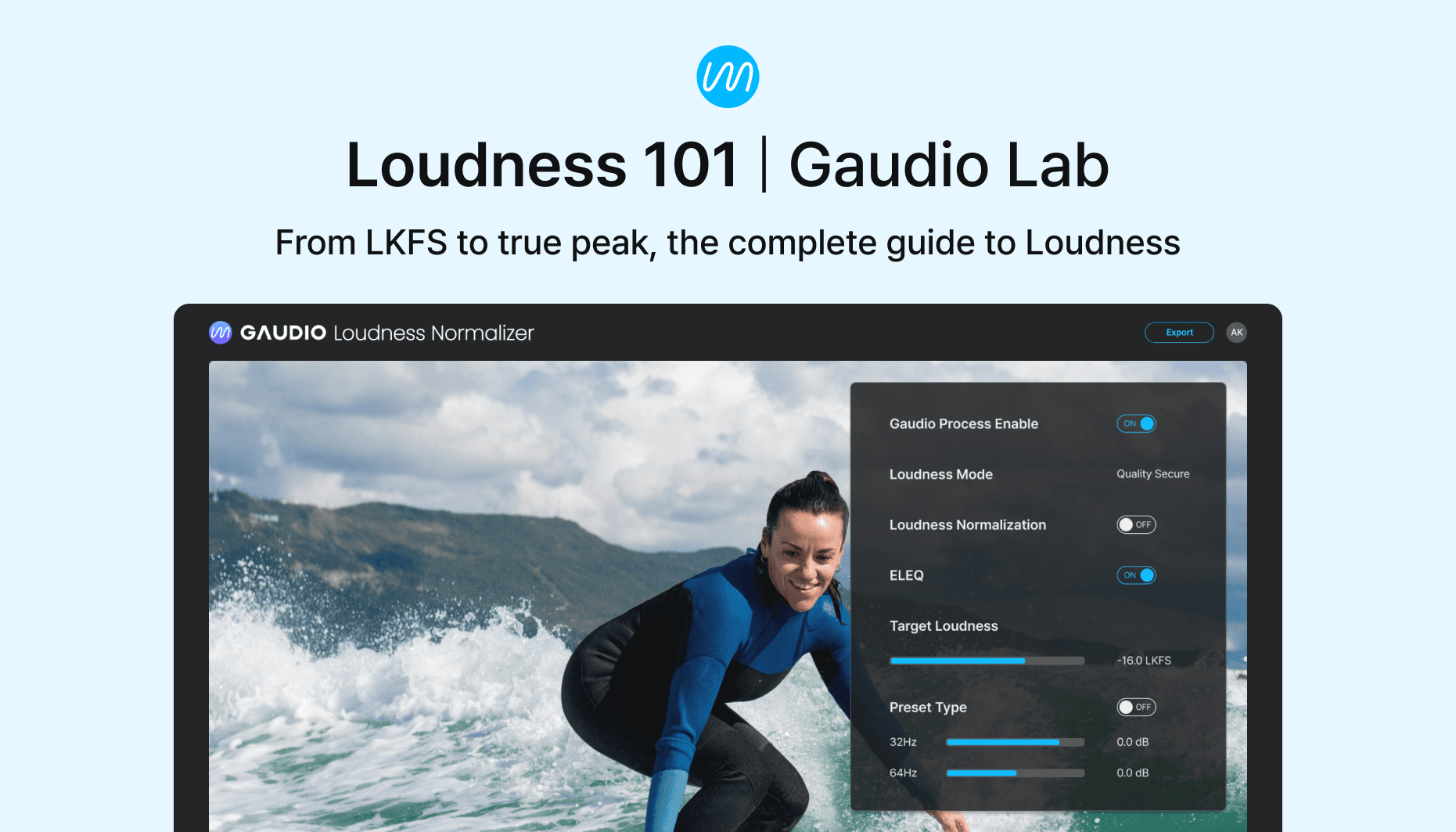
From LKFS to true peak, the complete guide to Loudness

      What exactly is loudness?   Loudness refers to the perceived amplitude of a sound as interpreted by human hearing. Imagine you want to tell someone about the volume of the song you're currently listening to. If the sound is loud, you'd say its loudness is high; if it's quiet, its loudness is low. However, there's no guarantee that another person will perceive loudness in the same way you do. This assurance diminishes as the number of people increases. In such cases, the most efficient method is to convey the sound's intensity using an objective, numerical metric or unit. Given the widespread need across various fields, research into loudness units has been very active. Here, we'll introduce a unit that is commonly used and highly practical in markets like broadcasting and streaming.   The unit we'll discuss is LKFS (Loudness K-Weighted relative to Full Scale), also known as LUFS (Loudness Unit relative to Full Scale). The parameters associated with this unit were developed by the ITU-R (International Telecommunication Union – Radiocommunication) and the EBU-R (European Broadcasting Union).       What factors are primarily considered when measuring loudness?   When measuring loudness, several key parameters are commonly used. If you examine the loudness meters provided in various measurement tools or Digital Audio Workstations (DAWs), you'll generally find that they include essential items such as Integrated, Short-Term, and Momentary loudness, True Peak, and Loudness Range. In this chapter, we will delve into the meaning of each of these parameters.   2-1. Key Keywords: LKFS, LU, Momentary Loudness, Short-term Loudness, Integrated Loudness, LRA, True-peak   LKFS (Loudness K-Weighted relative to Full Scale) a.k.a. LUFS (Loudness Unit relative to Full Scale) This is one of the units for loudness. It represents the amplitude of an input signal that has passed through a K-weighting filter, which is designed to align with human hearing characteristics. You can understand the K-weighting filter as one that increases signals in frequency ranges that humans hear relatively well, and decreases signals in frequency ranges that are relatively less audible. Loudness can be categorized into Momentary, Short-term, and Integrated Loudness based on the duration over which it is measured. Momentary Loudness refers to the sound level over a 0.4-second window, Short-term Loudness over a 3-second window, and Integrated Loudness represents the overall sound level across the entire duration.   *What are LKFS and LUFS, and what is the difference between them? The unit for loudness was initially conceived by the ITU (International Telecommunication Union), which defined the unit as LKFS (Loudness K-Weighted relative to Full Scale). Subsequently, the EBU (European Broadcasting Union) devised the display methods and defined terms such as Momentary, Short-term, and Integrated Loudness, along with Loudness Range (LRA), and then changed the designation to LUFS (Loudness Unit relative to Full Scale). Consequently, there is a tendency for LKFS to be used in North America, while LUFS is more prevalent in Europe.     LU(Loudness Unit) While LKFS represents an absolute measured value, LU (Loudness Unit) is a relative measurement. It is used to express the difference from a reference level or to describe the range of loudness. For example, if Content A is at -12 LKFS and Content B is at -20 LKFS, one could state, "Content A sounds 8 LU louder than Content B."   Momentary Loudness Momentary Loudness is the sound level corresponding to a 0.4-second segment of the signal after it has passed through a K-weighting filter. It is measured with a 75% overlap (0.1 seconds). This can be understood as the instantaneous sound level.         When the measurement results, as shown in the image above, are accumulated into a histogram, the result is as depicted in the image below.           The histogram of Momentary Loudness is subsequently used in the calculation of Integrated Loudness.     Short-term Loudness Short-term Loudness refers to the sound level corresponding to a 3-second segment of the signal after it has passed through a K-weighting filter. The EBU recommends that this value be updated at a minimum interval of 0.1 seconds.             The histogram of Short-term Loudness is subsequently used in the calculation of Loudness Range (LRA).     Integrated Loudness Integrated Loudness is the average sound level perceived across the entire duration of a piece of content. It represents the overall loudness of the content. The calculation method is as follows:   Step 1) Remove the momentary loudness distribution values below -70 LKFS, then calculate the average of the remaining distribution values.     Step 2) The relative threshold is defined as 10 LU lower than the average calculated in Step 1.      Step 3) The average of the distribution values that are above the relative threshold is the Integrated Loudness.       LRA(Loudness Range) LRA (Loudness Range) is a metric that indicates the variation in loudness over time within a single piece of content. It serves as an indicator of how widely the sound levels are distributed. The calculation method is as follows:   Step 1) Remove the short-term loudness distribution values below -70 LKFS, then calculate a value that is 20 LU less than the average of the remaining distribution values (this is the relative threshold).   Step 2) The difference between the top 5% of the distribution values and the bottom 10% of the distribution values that are above the relative threshold is the Loudness Range.       *In both Integrated Loudness (IL) and Loudness Range (LRA) calculations, the concept of a Relative Threshold is used, but their definitions differ. For IL calculations, momentary loudness is utilized, and the relative threshold is defined as the average of the values above the absolute threshold minus 10 LU. Conversely, for LRA calculations, short-term loudness is used, and the relative threshold is defined as the average of the values above the absolute threshold minus 20 LU.   True-peak True-peak refers to the peak value when a signal is converted to a 192 kHz sampling frequency, and its unit is dBTP. This value can be understood as a measure to prevent degradation in playback environments, particularly when using sufficiently high sampling frequencies (like 192 kHz). Since audio commonly consumed usually has sampling frequencies of 44.1 kHz or 48 kHz, upsampling is a common process. During this upsampling, the peak value can sometimes exceed the original sample peak value. An example of upsampling is provided below.     In addition to the core upsampling technique, other processes are undertaken to prevent the signal from exceeding its representable range (attenuation), to retain only valid signals after upsampling (filtering), and to convert values to the decibel scale (logarithmization). The block diagram below illustrates the series of steps involved in calculating the true-peak when the sampling frequency is 48 kHz.         2-2. Getting to know loudness           Why are LKFS (LUFS) used instead of the traditional RMS?   Previously, RMS (Root-Mean-Square) was used to measure loudness, but it did not align well with actual human auditory perception. Subsequently, the ITU and EBU developed a more sophisticated method for calculating loudness by incorporating a K-weighting filter to reflect human hearing capabilities. As seen in the loudness calculation process, this method also excludes parts that have no influence on the perception of sound pressure. It is likely that this more refined approach, compared to other units, has led to its widespread adoption.       What is the 'Loudness War' and why is it a problem?   I'd like to discuss an issue related to loudness that many of you might already be familiar with: the 'Loudness War.' To summarize it in my own words, it's when content creators produce content with the mindset of, "By making my creation louder than others, I will grab more attention from listeners. As a bonus, it might even trick listeners into thinking the sound quality is better." Alternatively, it could also be a mindset of, "While I won't make my creation significantly louder than others, I'll ensure there isn't a large difference." While a louder sound might lead one to believe the sound quality has improved, in reality, the dynamic range narrows, reducing expressiveness, and the frequency of clipping increases, raising the probability of sound quality degradation. I hope that many consumers will recognize that excessively increasing loudness actually diminishes the quality of the audio itself, and that their consumption patterns will change accordingly.     Loudness Regulations and Recommendations for Streaming Platforms  (masteringthemix)       Hopefully, your questions about loudness have been answered!   This post is a translated version of 'Loudness 101 (KR)', originally published in 2019.   If you're looking for more in-depth or specialized information, we highly recommend consulting the following international standard documents, which contain detailed technical information on loudness measurement and regulation: ITU-R BS.1770-4: provides the standard for loudness measurement algorithms. EBU-R Tech 3341, 3342: offers detailed guidelines on loudness regulation and measurement methods in broadcasting environments.   If you have any further questions about loudness or Gaudio Lab's loudness technologies, please feel free to contact us!           Would you like to know more about loudness? Perceived loudness Loudness Management: How audio technology will impact streaming video      

2025.07.18