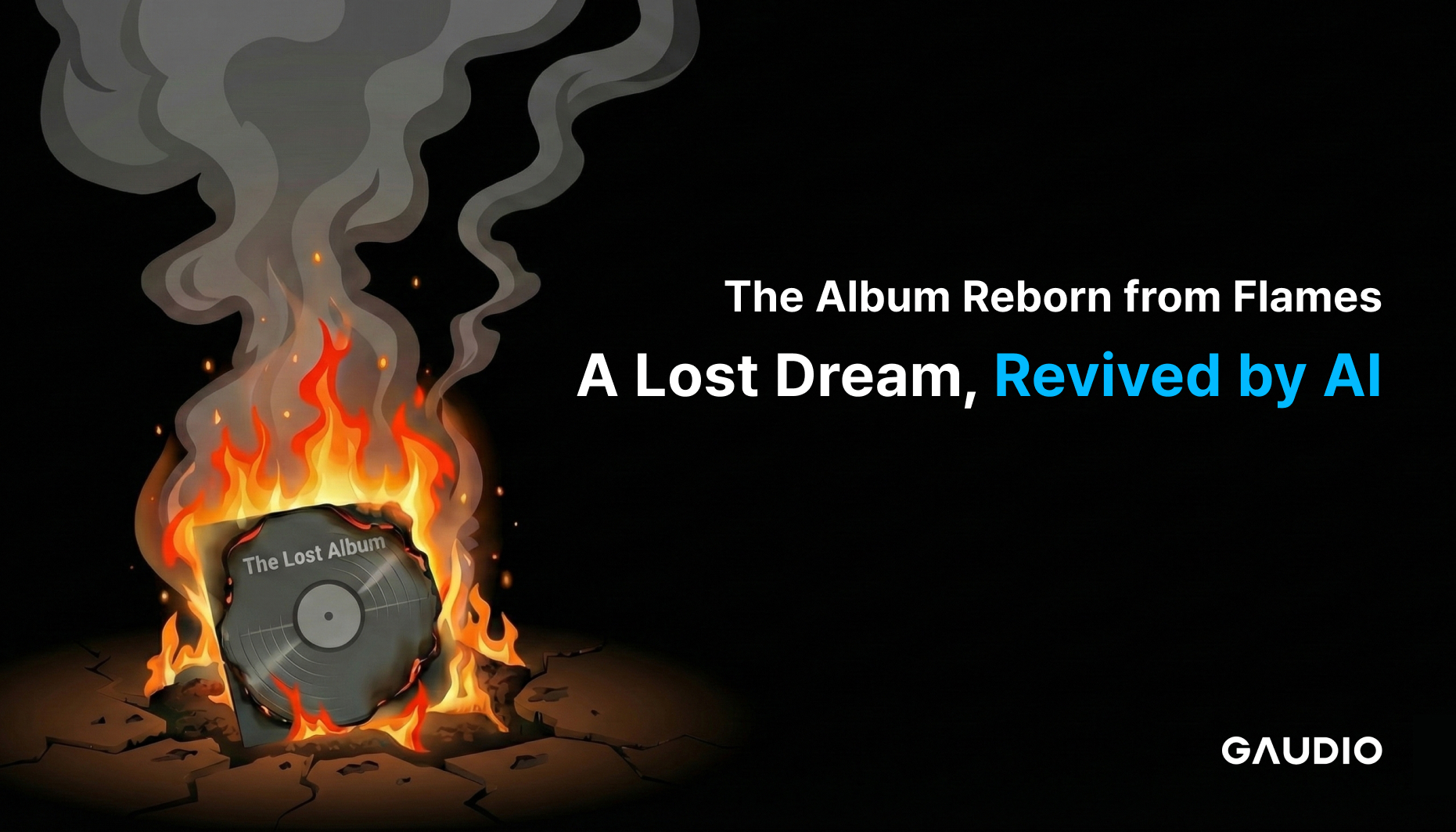
The Album Reborn from Flames: A Lost Dream, Revived by AI
2025.12.09ㆍ by Dewey Yoon


The Album Reborn from Flames: A Lost Dream, Revived by AI


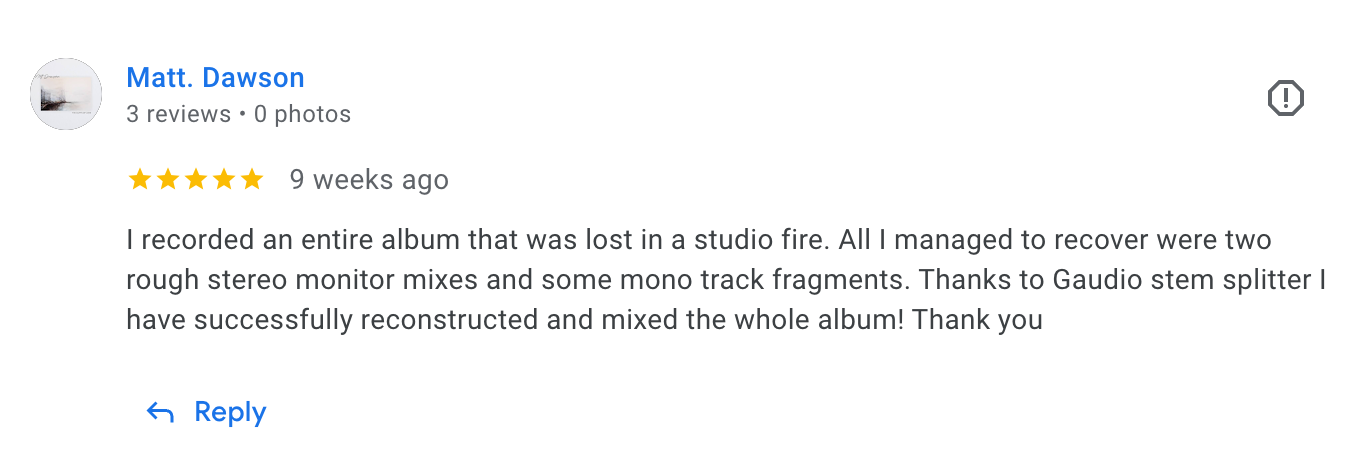
One day, an unexpected review appeared on Gaudio Lab’s Google Maps page.


It told the astonishing story of a precious album that had been completely destroyed in a studio fire — and how, thanks to AI technology, it was able to come back to life.


Naturally, we wanted to know more about the story behind it.


“The Lost Album — asleep in a vault for decades.”


In 2011, British composer and producer Matt Dawson recorded what he believed would become the defining album of his career.


The collaborators? None other than Albert Lee & Hogan’s Heroes — legendary musicians who helped shape the British music scene.


As a longtime fan of Albert Lee, Dawson was lucky to cross paths with him by chance, leading to two incredible days spent recording together.


Over those two days, Dawson captured performances that felt like a dream.


There was laughter throughout the sessions, and with such world-class musicians in the room, every track was exceptional in quality.


As expected, Albert’s playing was phenomenal, and his energy filled the room with inspiration.


It was a gem of a moment — a series of raw, honest, and unbelievably vivid performances, now captured on tape.


But the joy was short-lived. After finishing the recording and sharing a final dinner together, Dawson returned to his studio — only to witness a heartbreaking sight. His studio was in flames.


The fire had destroyed all of the original multitrack tapes from the session. Thankfully, a few rough stereo mixes had been stored elsewhere, but the album itself was, for all intents and purposes, lost.


“I was heartbroken but at least managed to save a handful of rough stereo mixes.”

– Matt Dawson


He gently packed the remnants of the session into a box and stored it in his basement. And time kept passing. A story that seemed like it had reached a tragic ending… didn’t end there.



The scene of Matt Dawson’s studio after it was burned down.


Music Resurrected by AI: “I never imagined these songs would be heard again.”


Dawson never gave up hope.


In his long journey to revive the album, Dawson had been experimenting with various new software tools. Then in 2025 — more than a decade after the fire — he came across GSEP (Gaudio Source SEParation) by Gaudio Lab.


This powerful AI engine allowed Dawson to extract vocals and instruments from stereo mixes with studio-level precision. Unlike basic karaoke-style vocal removal tools, GSEP provided high-resolution stem separation. This was the breakthrough he needed.


Using Gaudio Studio, Excited by the potential, Dawson began fully reconstructing the album.


He extracted instrumental and vocal parts from different sessions — even recordings made in different years and at different tempos and keys — and combined them with newly recorded instrumentals. With careful editing, The Lost Album was reborn in a new form, richer and more complete than he’d ever imagined.


AI for Good: A Story Beyond Technology


This story is not just about technology.

It’s about people — their memories, dreams, and hope.


The sessions with Albert Lee and his band weren’t just recordings.

They shared stories, enjoyed late-night meals together, and created music side by side. It was a dreamlike experience — making music with artists he deeply admired.

AI wasn’t there in that moment. But more than ten years later, it helped bring that moment back to life.


Technology for All Creators


The Lost Album is not just a one-off miracle.

Gaudio Lab’s GSEP technology can help creators in a wide range of scenarios:


  • Remove noise from field recordings
  • Separate stems from stereo master files
  • Replace or isolate specific tracks
  • Extract Dialogue / Music / Effects (D/M/E) layers for post-production
  • And much more — anything involving the separation of sound.


“Gaudio Lab didn’t create the music. We built the tools to restore lost opportunities.”

– Henney Oh, CEO of Gaudio Lab


Need Help with Audio?


Do you have a missing dialogue track?

A noisy broadcast recording?

A corrupted music file?


Try our tools:


If you’re looking for premium results, we’re here to help.

Gaudio Lab is home to the world’s leading experts in AI audio engineering — ready to assist with your most challenging audio problems.


The World’s Best AI for Source Separation


Contact Gaudio Lab

We’re always open to helping creators reclaim their sound. Let us know how we can support you.


Listen to The Lost Album by Matt Dawson


pre-image
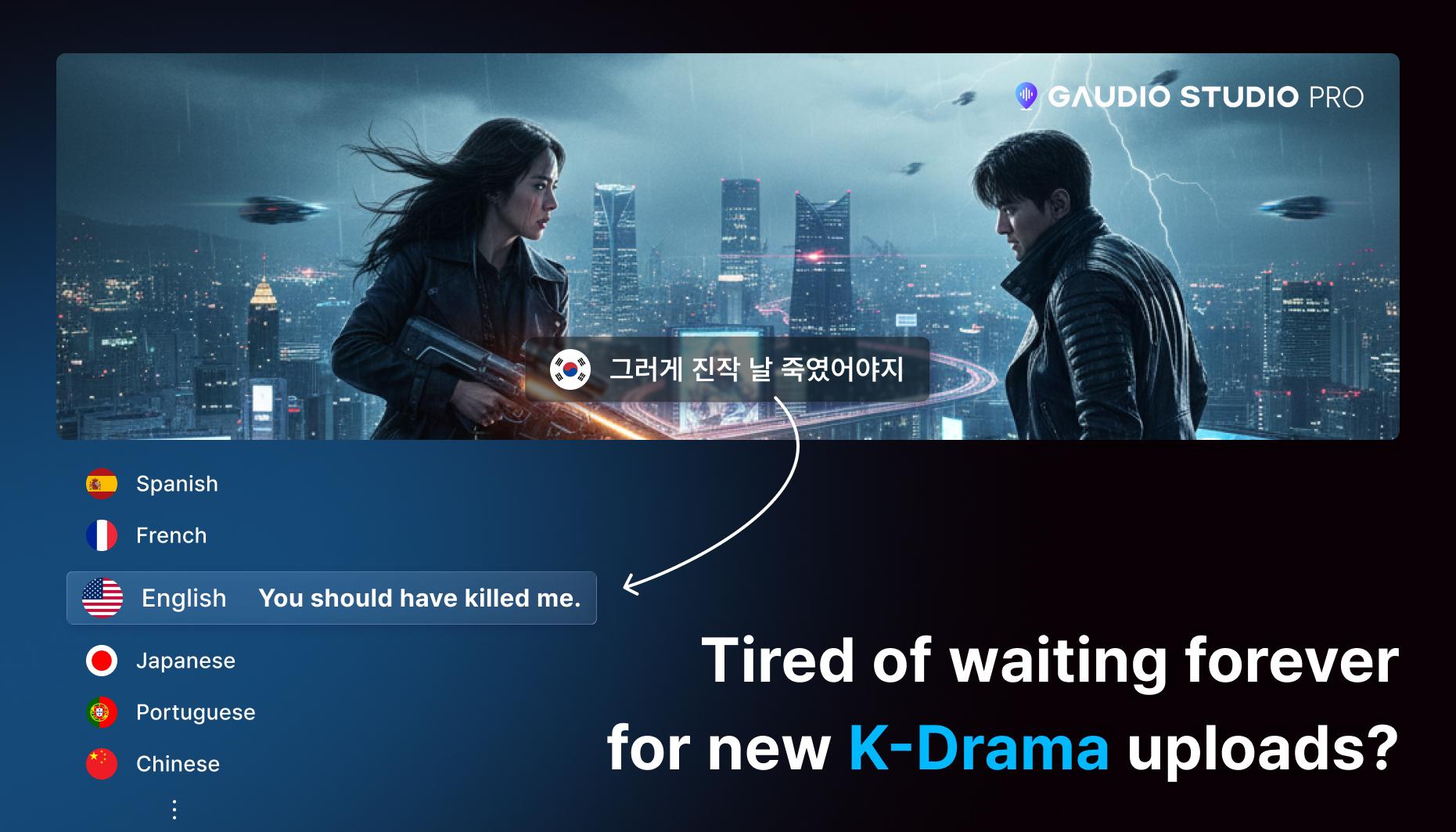
Tired of waiting forever for new K-Drama uploads?

Tired of waiting forever for new K-Drama uploads? You might not have to wait much longer. A movement to distribute K-content 10× faster worldwide through AI     K-pop, K-dramas, and Korean variety shows have become familiar sights across the globe. In online communities dedicated to sharing Korean content, questions like “When will today’s episode be uploaded?“, “Is there a way to watch it outside Korea?“, or “How do I use a VPN?” appear constantly. People even share platform recommendations and viewing hacks. Until now, global viewers had to wait at least two weeks—and sometimes several months—after a Korean broadcast. But this waiting time is expected to shrink dramatically very soon. Why is that?   Korea Is Now Testing “K-FAST”  The Korean government and private companies are running an initiative to rapidly spread K-content worldwide through FAST channels. The strategy centers on combining AI automation with Human-In-The-Loop (HITL) expertise. FAST (Free, Ad-Supported, Streaming TV) channels operate on a “Free + Ad-supported” model, which limits how much time and budget can be invested. Delivering Netflix or Disney+ level localization quality under these constraints is nearly impossible. Still, viewers expect quality that feels natural and comfortable. This requires maintaining the creator’s original intent while adapting to regional cultural nuances — a delicate balance Korea aims to solve with AI.   Why Did Global Viewers Have to Wait So Long for K-Dramas?  Exporting a drama involves far more than adding subtitles. Transcription, subtitling, music replacement, dubbing, loudness adjustment, remastering, quality checks… and more. The workflow is complex, and multiple vendors often share the work, naturally extending timelines. And as the saying goes, “time is money,” costs can rapidly snowball. In the K-FAST experiment, Korea is making a bold shift from a subtitle-focused workflow to a dubbing-first approach — something previously avoided due to cost and technical constraints. (Fun fact: In North America, viewers watch dubbed content about seven times more than subtitled content.) For older series and films, there’s an additional challenge: many have lost their D/M/E (Dialogue, Music, Effects) files, which are essential for re-production. As a result, countless classic works have remained locked away for years.   Faster, More Affordable, Higher Quality — and Even a Revival of Classics  As K-content’s popularity rises, Korean studios are flooded with export requests. Localization speed has essentially become a measure of global competitiveness. Fortunately, Korea has a company capable of solving these challenges with AI. Three years ago, Gaudio Lab introduced its own AI audio-separation technology. After years of development, it released Gaudio Studio Pro (GSP) — a comprehensive solution for content localization and re-versioning.   How Does GSP (Gaudio Studio Pro) Work? Using its AI source-separation engine, GSP cleanly extracts D/M/E from the original content. This instantly addresses common roadblocks to global distribution — missing M&E tracks, music copyright issues, lack of stem files, and more.  The clean dialogue is then translated and dubbed using AI. After minor script edits, files are uploaded into GSP, where carefully crafted prompts and a small amount of human touch raise quality further. Background music is automatically replaced with copyright-clear tracks. The speed is over 10× faster than existing workflows. AI precisely identifies and replaces only the required music segments. Users can preview, re-request recommendations, or adjust sections to better preserve the original intent. Importantly, all replacement tracks are high-quality, human-made music, not AI-generated — sometimes even revealing hidden gems that rival the original soundtrack. Many older works have only a single master file without segmented D/M/E, making re-production impossible. But once processed with GSP, these classics can finally cross borders again. It’s a true revival of global heritage. By automating the entire pipeline, tasks that once took over a month can now be completed 90% faster.   From Traditional Dubbing to AI-Powered GSP… and a Double Win at CES 2026  Traditional dubbing required dozens of voice actors, studios, engineers, producers, and scriptwriters. With GSP, a single dubbing producer can manage the entire process. Premium legacy titles can be restored and distributed worldwide through advanced separation technology. This workflow is already powering the global expansion of popular Korean shows like Running Man. GSP’s quality has even been validated by a major Japanese broadcaster known for its extremely strict standards — a strong signal that Gaudio Lab’s technology meets FAST-market expectations.       GSP’s ability to break global distribution barriers earned it two CES 2026 Innovation Awards. Its flexibility, business potential, and technical excellence — enabling global release of both new and archival content — received high marks. Thanks to automatic music replacement powered by a library of over 110,000 high-quality human-made tracks, GSP quickly resolves legal bottlenecks that typically slow down global content delivery, resulting in enthusiastic interest from companies worldwide. Gaudio Lab’s broader portfolio — including source separation, instrument isolation, real-time noise removal, spatial audio, and loudness normalization — has earned CES Innovation Awards four years running, cementing its position as a world-leading audio technology company.     Solving One of AI Audio’s Toughest Problems  One of the hardest challenges in AI audio separation — and a point where many companies fail — is when two actors are speaking while background music includes lyrics. Most AI separators confuse vocals with dialogue, leaving messy results. Gaudio Lab’s models, however, are specially trained to differentiate speech from singing, enabling cleaner and far more accurate separation. This gives GSP a major advantage in producing FAST-ready content quickly and reliably. It’s also why an increasing number of content exporters are turning to Gaudio Lab.   HITL (Human in the Loop): Perfecting the Final 1%  AI adoption in production workflows has been met with excitement — and hesitation. Many still say, “It needs human review,” “It’s not fully ready,” or “It can feel unnatural.” Concerns about compromising the original quality remain common. HITL bridges that gap. AI handles time-consuming or technically difficult tasks, while humans focus on creative decision-making, contextual nuance, and artistic quality. This combination lowers the barrier to global content distribution without sacrificing authenticity. Gaudio Lab has built an internal HITL expert team that oversees prompt design, workflow supervision, and manual refinements whenever needed. According to Gaudio Lab, “Team members using AI have significantly improved their project-management capabilities, with rapid growth in skill and proficiency.” They add, “By working on hundreds of titles, we’ve created a positive cycle — faster output, higher quality, and stronger team expertise.”   Who Is Gaudio Lab?  Gaudio Lab is Korea’s leading AI audio company, renowned for its world-class AI source-separation technology. It has earned global recognition through: CES Innovation Awards for four consecutive years (2023–2026) — SXSW Innovation Awards finalist (2024)— ANSI/CTA international standard adoption (2022)— ISO/IEC MPEG-H standard adoption (2013, 2018)— VR Awards ‘Best VR Innovation Company of the Year’ (2017) At CES 2024, Microsoft CEO Satya Nadella personally visited the Gaudio Lab booth, experienced the technology, and exclaimed “Amazing,” drawing industry-wide attention. The company includes more than 40 audio experts worldwide, including eight PhDs in audio engineering, an extremely rare concentration even globally. Gaudio Lab provides advanced audio solutions across OTT, streaming, AR/VR, smartphones, cinemas, and automobiles — anywhere sound matters.    

2025.11.25