How can broadcasters localize content faster?
Gaudio Studio Pro (GSP) is here
to help anyone dealing with the challenges of conventional localization processes
In today’s global media landscape, speed and scale matter more than ever. Broadcasters and distributors face mounting pressure to prepare films and shows for multiple regions at once—but traditional localization workflows are slow, fragmented, and often blocked by missing D/M/E tracks or music rights issues.
That’s why Gaudio Studio Pro (GSP) was built: a cloud-native, AI-powered localization platform that removes the barriers between great content and global audiences, with expert (human)-in-the-loop support for even better quality and reliability.
For reference, Gaudio Lab provides information about this technology through a dedicated GSP portal, allowing customers to experience it firsthand.
We’ve gathered the top questions broadcasters and distributors ask about GSP—and the answers that show how it can cut turnaround time by up to 90%, simplify copyright compliance, and unlock new revenue from both new and legacy titles.
Product Overview & Target Users
Q: What is Gaudio Studio Pro (GSP)?
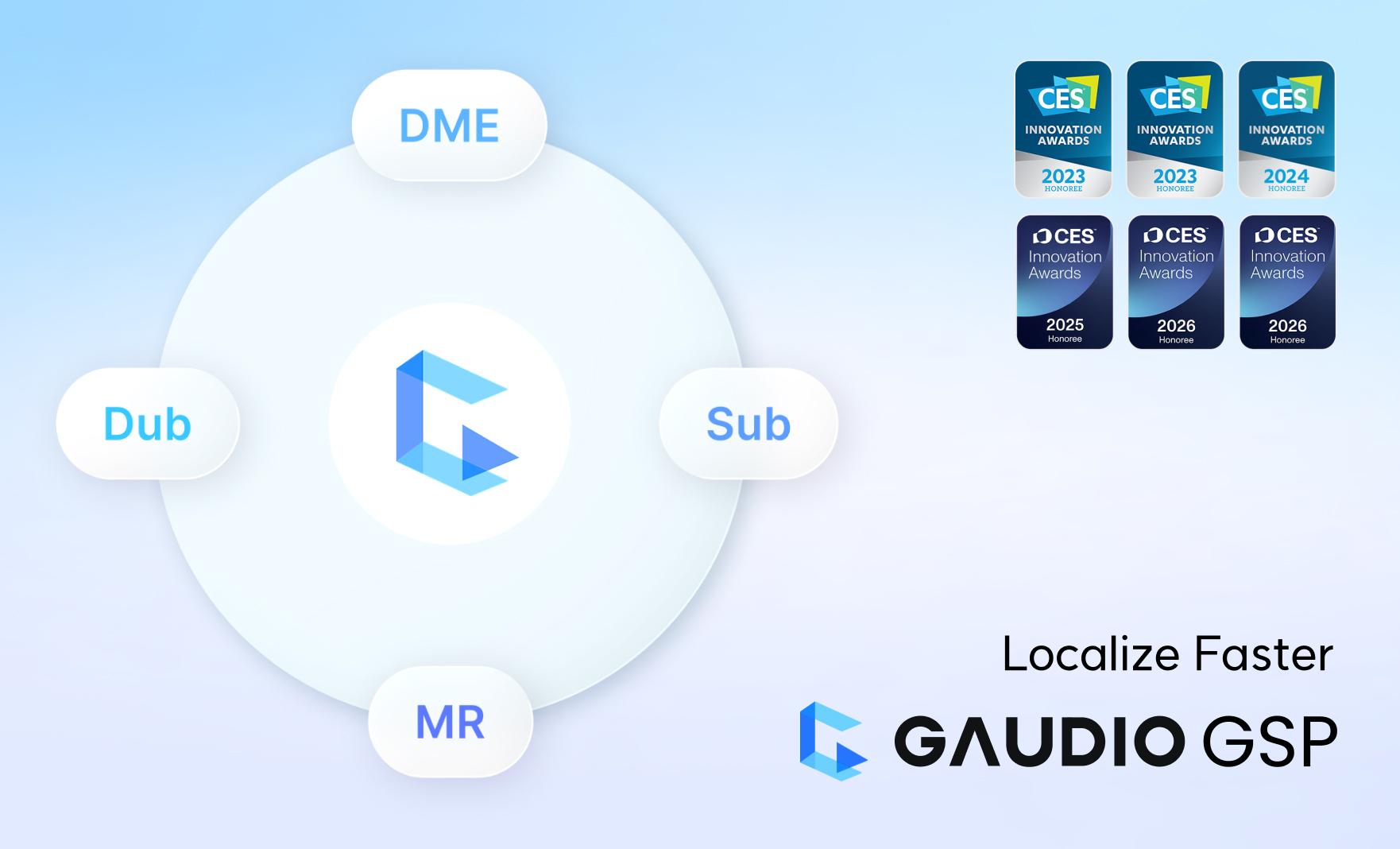
GSP is a cloud-native content localization SaaS designed for film and broadcast industries. It automates DME separation, dubbing, subtitle syncing, music replacement, and cue sheet generation—even when only the final master file is available (no D/M/E stems). With award-winning AI audio separation and copyright-cleared music replacement, GSP turns any film—old or new—into a distribution-ready asset for global markets.
We also offer expert services from our audio post-production team, WAVELAB, to ensure quality and adapt localization to your project’s needs.
Q: Who is GSP for?
GSP is designed for studios, filmmakers, broadcasters, OTT platforms, distributors, and post-production teams who need to prepare content for international release. It’s also useful for archives and rights holders who want to revive legacy titles for new markets.
Q: Can smaller studios or indie filmmakers use GSP?
Absolutely. While GSP supports large broadcasters and distributors, it’s also designed to be accessible for everyone—from directors and engineers to translators and indie creators who want to prepare their content for global release. Its intuitive interface and automation reduce the need for technical expertise or large budgets.
Q: Has GSP been recognized in the industry?
Yes. GSP’s core technologies—AI Audio Separation, AI Music Recommendation, and loudness management—have won CES Innovation Awards (2023–2025). The loudness management technology is also an official ANSI/CTA standard, widely adopted across the industry.
Q: Is there a free trial version available?
Yes, you can check it out right away. Having trouble exporting your content? You can try out the technology in advance through the GSP portal — completely free of charge.
Q: Have you worked with overseas clients?
Yes. We are working and conducting PoCs with a number of Korean companies and several companies in the U.S., Japan, and Europe.
Key Features & Workflow
Q: What makes GSP different from traditional localization tools?
All-in-one workflow: DME Separation, dubbing, subtitles, music replacement, and cue sheets in one platform.
Expert service from our audio post-production team, WAVELAB, for customers who want even better quality.
AI-powered automation: Faster turnaround (up to 90% reduction in localization time).
Legal readiness: Music replacement without copyright issues
Cloud-native collaboration (coming soon): Real-time comments, multitrack editing, and version tracking.
Q: Can GSP be used for live broadcasting or only for pre-recorded content?
GSP is primarily designed for film, OTT, and broadcast post-production, so unfortunately, our current technology cannot handle live broadcasting scenario. In the future, however, processing speed may improve to make it feasible.
Q: Can GSP be integrated into existing production pipelines?
Yes. GSP is built as a cloud-native SaaS, so teams can use it alongside existing video editing tools or dubbing studios. Its format-flexible export ensures compatibility with any distribution workflow.
Q: How does GSP support collaboration across teams?
GSP includes multitrack editing and version control, making it easier for translators, engineers, and producers to work together—even across time zones. Everyone works on the same project environment, eliminating file conflicts and delays.
Efficiency & Productivity
Q: How fast is localization with GSP?
By consolidating multiple fragmented tools into a single AI-powered tool, GSP can reduce localization time by up to 90%—cutting months of work down to days—without compromising quality.
To put it more specifically, without human-in-the-loop (i.e., AI-only processing), localizing one hour of content that once took a month now takes just one hour. When expert quality checks and edits are added, the same work that once took a month can now be completed in about three days.
Q: Is GSP scalable for large catalogs?
Yes. GSP was designed for enterprise-level scalability. Whether localizing a single short film or processing entire archives with hundreds of titles, it handles projects in parallel while keeping version control and collaboration centralized.
Q: How does GSP save costs compared to traditional localization?
No need to rebuild missing D/M/E stems from scratch.
Automated solutions that alleviate music copyright concerns and cue sheet generation reduce manual labor.
Faster turnaround (up to 90% time savings) means lower studio and staffing costs.Overall, GSP lets studios localize more titles with fewer resources.
Q: What kind of revenue opportunities does GSP unlock?
By restoring and clearing rights for films that were previously stuck in archives, GSP allows studios and distributors to monetize dormant catalogs. It also shortens time-to-market for new releases, helping companies reach more global audiences faster.
Also, it empowers music artists to earn from their original creations. Artists can easily register their music in the GSP library, while users discover fresh tracks through AI-driven recommendations—creating a new ecosystem that connects broadcasters and musicians.
Feature-Specific Questions
DME Separation
Q: How does GSP handle projects when only a master file is available?
Even without original dialogue, music, and effects (DME) stems, GSP’s AI audio separation engine extracts DME with studio-level fidelity. This makes it possible to restore, localize, and repackage films that were previously blocked from distribution.
Q2: How accurate is GSP’s DME separation?
GSP uses Gaudio Lab’s proprietary AI stem separation model —one of the most advanced in the world. Its separation performance has been ranked No. 1 by Musicradar, MusicTech, and LANDR. Providing studio-level fidelity, GSP extracts dialogue, music, and sound effects cleanly even from legacy or compressed master files.
Music Replacement
Q: How does GSP's Music Replacement handle copyright issues?
Even a single copyrighted background track can block international release. Content distribution often stalls due to music rights issues. GSP alleviates them by recommending and replacing tracks from a globally licensed library of 110K+ human-made, high-quality music.
Q: Does GSP use AI-generated music for replacements?
No. GSP’s replacement library features 110K+ tracks composed by real artists, not generative AI. Its AI recommends and places the most fitting track, ensuring the emotional tone of the original BGM is preserved while maintaining full copyright clearance.
Q: How accurate is the AI in replacing the original music with suitable alternatives?
It depends on the genre you want to replace. For variety shows, replacement is essentially fully automated. For dramas, the numerical accuracy is similar, but the acceptance level or creative bar is much higher. Still, only about 10% of tracks may need human review.
Q: Can the AI adapt to different types of video content, like documentaries and commercials?
Commercials can certainly be processed with GSP, but given their short format and the need for a single strong track, advertisers often prefer to handpick music from recommended options.
For documentaries, the results are even better than with variety shows. Since the number of music mixes is smaller and the takes are longer—typically 2–3 minutes per track—the replacement process is smoother and more consistent.
Q: Can the AI handle various music genres and cultural nuances?
Yes. For example, if the original music is reggae, the recommended replacements will usually come from the same genre, since tempo, instrumentation, and melody align.
Dubbing & Subtitle Synchronization
Q: How does AI dubbing in GSP work?
GSP’s AI dubbing faithfully replicates the original actor’s voice, tone, and timing in the target language. Powered by Gaudio Spatial Audio, CES Innovation Award-winning technology, it even matches scene-specific room tone and spatial effects—so a voice in a poolside scene, for example, sounds naturally wet and reverberant, not like a dry studio recording.
Q: How does GSP automate subtitle synchronization?
GSP uses AI to automatically generate and synchronize subtitles with dialogue tracks. Even when only the master file is available, it aligns timing accurately—producing high-quality subtitles that comply with the strict timing guidelines of the largest video streaming platforms—reducing manual adjustment time and ensuring subtitles match the original speech and scene context.
Q: Can subtitle translations be customized?
Yes. Editors and translators can directly review and edit subtitles. Once the real-time collaboration feature is updated, multiple team members will be able to refine translations simultaneously without any version conflicts.
Q: Does GSP support multiple languages simultaneously?
Absolutely. GSP can generate and manage subtitles in multiple target languages at once, streamlining international releases.
Cue Sheet Generation
Q: Can cue sheets be exported in standard formats?
Yes. GSP exports cue sheets in industry-standard formats compatible with broadcasters, OTT platforms, and regulatory requirements worldwide.
Localize your content fast with Gaudio Studio Pro
GSP is redefining how broadcasters, studios, and distributors bring stories to global audiences. By combining AI-driven efficiency with industry-standard compliance, it doesn’t just solve the challenges of traditional localization—it opens up new opportunities for revenue, scale, and creativity.
Whether you’re preparing a single indie film or scaling an entire archive, GSP helps you move faster, stay compliant, and connect with audiences worldwide.
👉 Ready to see how GSP can transform your workflow?
Let’s make your content truly global.
🔥 Experience GSP Now!
✉️ Contact us for more information
📖 Read more about Music Replacement
📖 Read more about how GSP handles music copyright issues
2025.08.28