Quickstart
This document explains the complete process of creating a job and checking its status using the API provided by Gaudio Developers.
In this demo, we'll create a job to separate vocal and accompaniment elements from mixed audio using the GSEP-Music-HQ model.
Workflow
The diagram below shows the complete process of creating a job, periodically checking its status, and confirming until the task is completed.
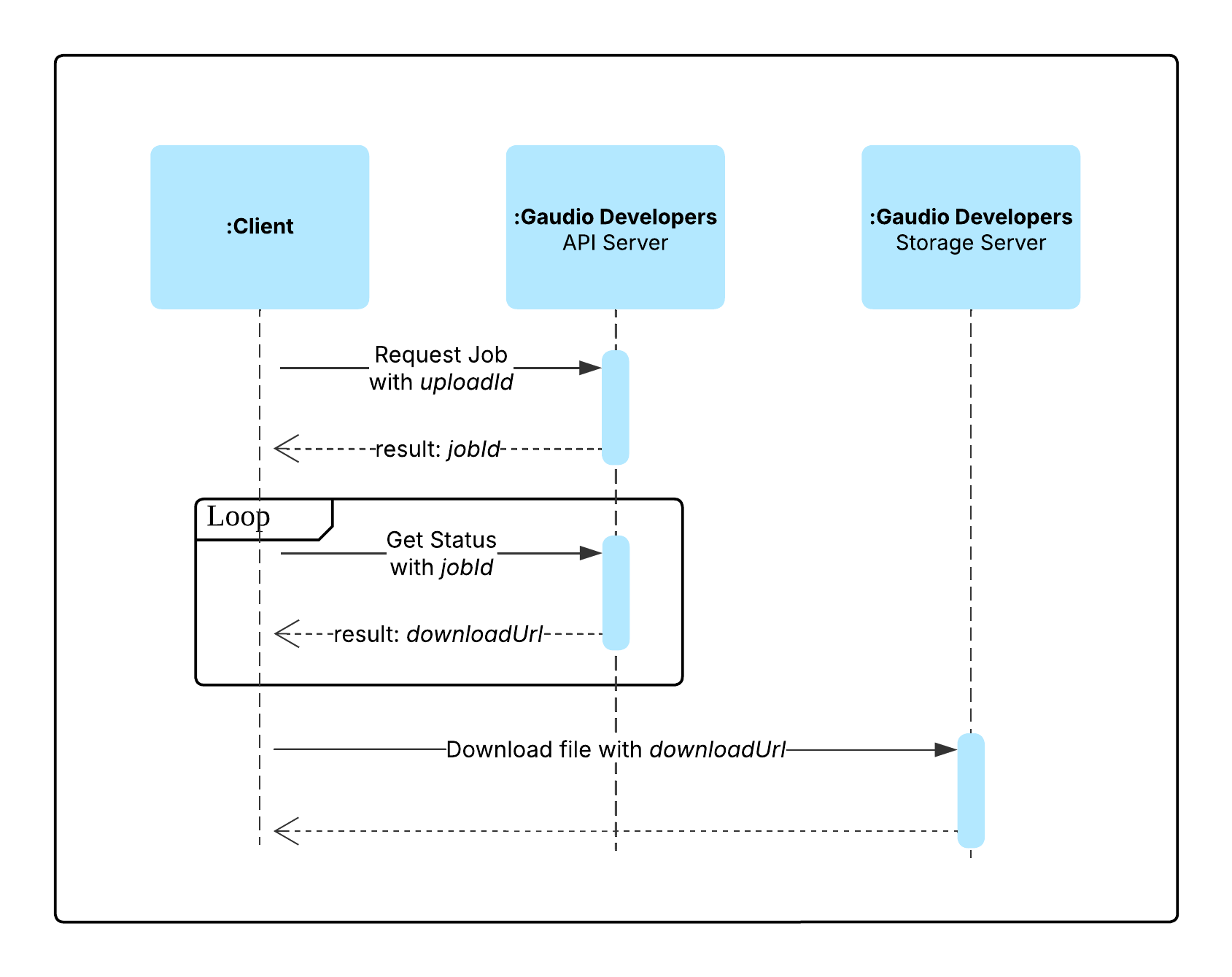
- Call the job creation API.
- Repeatedly call the status check API with the returned jobId.
- Download the result files once the task is completed.
Job Status
Jobs can have the following statuses:
| Status | Description |
|---|---|
waiting | The job has passed validation and entered the queue. Processing time may be longer if there are many jobs waiting in the queue. |
running | The job is currently being processed. Processing time varies depending on the product, processing options, and input file. |
success | The job has been completed successfully and results can be downloaded. |
failed | An error occurred during job processing and it failed. |
When the status is
success, you can download the result files through thedownloadUrlincluded in the response.
Step-by-Step Guide
Prerequisites
- Authentication Information
- All requests require authentication using an API Key. For issuance and creation methods, please refer to the Authentication document.
- Upload ID
- You need to upload the source audio file to the temporary upload server and receive an ID. For upload and ID issuance methods, please refer to File Upload.
1. Create a job
Create a job using the uploadId of the uploaded file.
curl -X POST https://restapi.gaudiolab.io/developers/api/v1/gsep_music_hq_v1/jobs \
  -H "x-ga-apikey: {API_KEY}" \
  -H "Content-Type: application/json" \
  -d '{
        "audioUploadId": "{UPLOAD_ID}",
        "type": "vocal,drum"
      }'
Response on success
{
  'resultCode': 1000,
  'resultData': {
    'jobId': 'aaffd346-74fc-11f0-8de9-0242ac120002'
  }
}
2. Get a job
Check the current status of the job using the Job ID.
curl -X GET "https://restapi.gaudiolab.io/developers/api/v1/gsep_music_hq_v1/jobs/{JOB_ID}" \
  -H 'x-ga-apikey: {API_KEY}'
Response on success
{
  'resultCode': 1000,
  'resultData': {
    'jobId': 'aaffd346-74fc-11f0-8de9-0242ac120002',
    'status': 'success',
    'expireAt': '2025-09-01T12:00:00Z',
    'downloadUrl': {
      'vocal': {
        'mp3': 'https://cdn_url/input-file_vocal.mp3',
        'wav': 'https://cdn_url/input-file_vocal.wav'
      },
      'drum': {
        'mp3': 'https://cdn_url/input-file_drum.mp3',
        'wav': 'https://cdn_url/input-file_drum.wav'
      },
      'others': {
        'mp3': 'https://cdn_url/input-file_others.mp3',
        'wav': 'https://cdn_url/input-file_others.wav'
      }
    }
  }
}
- If the status is not 'success' or 'failed', it is still being processed.
- If you make repeated requests too frequently, you may hit rate limiting. (For detailed information, please refer to the Rate Limiting document.)
Example Code
Below is a Python example that includes the entire process.
import os
import requests
import time
import json

SLEEP_INTERVAL = 10
SERVER = "https://restapi.gaudiolab.io/developers/api"

API_CREATE_UPLOAD = "/v1/files/upload-multipart/create"
API_COMPLETE_UPLOAD = "/v1/files/upload-multipart/complete"
API_CREATE_JOB = "/v1/gsep_music_hq_v1/jobs"
API_JOB_STATUS = "/v1/gsep_music_hq_v1/jobs/{}"

API_KEY = 'api_key_here'
INPUT_FILE = './test_file.wav'


def send_request(method, api, payload):
    headers = {
        'x-ga-apikey': API_KEY
    }
    if method == "POST":
        return requests.post(SERVER + api, headers=headers, json=payload)
    elif method == "GET":
        return requests.get(SERVER + api, headers=headers)
    else:
        raise ValueError(f"Invalid method: {method}")

def read_in_chunks(file_object, chunk_size):
    while True:
        data = file_object.read(chunk_size)
        if not data:
            break
        yield data


def main():
    print("\n[STEP] Create Upload URL")
    print("-" * 40)
    file_size = os.path.getsize(INPUT_FILE)
    payload = {
        'fileName': os.path.basename(INPUT_FILE),
        'fileSize': file_size
    }
    create_resp = send_request("POST", API_CREATE_UPLOAD, payload)
    if create_resp.status_code != 200:
        print(f"  ERROR) Request failed: status_code {create_resp.status_code}, {create_resp.text}")
        return

    result_code = create_resp.json().get('resultCode')
    if result_code != 1000:
        result_message = create_resp.json().get('resultMessage')
        print(f"  ERROR) Create upload url failed: resultCode {result_code}, resultMessage {result_message}")
        return

    result_data = create_resp.json()['resultData']
    upload_id = result_data['uploadId']
    chunk_size = result_data['chunkSize']
    urls = result_data['preSignedUrl']
    print(f"  SUCCESS) uploadId: {upload_id}")
    print(f"  SUCCESS) chunkSize: {chunk_size} bytes")
    print(f"  SUCCESS) chunks: {len(urls)}")


    print("\n[STEP] Upload File")
    print("-" * 40)
    parts = []
    with open(INPUT_FILE, 'rb') as f:
        print(f"  INFO) Uploading {len(urls)} chunk(s)")
        for i, chunk in enumerate(read_in_chunks(f, chunk_size)):
            resp = requests.put(urls[i], data=chunk)
            etag = resp.headers.get('ETag', '').replace('"', '')
            parts.append({'awsETag': etag, 'partNumber': i + 1})
            print(f"    PROGRESS) chunk {i + 1}/{len(urls)} uploaded")


    print("\n[STEP] Complete Upload")
    print("-" * 40)
    complete_payload = {'uploadId': upload_id, 'parts': parts}
    complete_resp = send_request("POST", API_COMPLETE_UPLOAD, complete_payload)
    if complete_resp.status_code != 200:
        print(f"  ERROR) Request failed: status_code {complete_resp.status_code}, {complete_resp.text}")
        return

    result_code = complete_resp.json().get('resultCode')
    if result_code != 1000:
        result_message = complete_resp.json().get('resultMessage')
        print(f"  ERROR) Upload complete failed: resultCode {result_code}, resultMessage {result_message}")
        return

    print("  SUCCESS) Upload completed successfully")


    print("\n[STEP] Create Job")
    print("-" * 40)
    job_payload = {'audioUploadId': upload_id, 'type': 'vocal,drum'}
    job_resp = send_request("POST", API_CREATE_JOB, job_payload)
    if job_resp.status_code != 200:
        print(f"  ERROR) Request failed: status_code {job_resp.status_code}, {job_resp.text}")
        return

    result_code = job_resp.json().get('resultCode')
    if result_code != 1000:
        result_message = job_resp.json().get('resultMessage')
        print(f"  ERROR) Create job failed: resultCode {result_code}, resultMessage {result_message}")
        return

    result_data = job_resp.json()['resultData']
    job_id = result_data['jobId']
    print(f"  SUCCESS) jobId: {job_id}")


    print("\n[STEP] Check Job Status")
    print("-" * 40)
    while True:
        print(f"    PROGRESS) Checking job status...")
        status_resp = send_request("GET", API_JOB_STATUS.format(job_id), {})
        if status_resp.status_code != 200:
            print(f"  ERROR) Request failed: status_code {status_resp.status_code}, {status_resp.text}")
            break

        result_code = status_resp.json().get('resultCode')
        if result_code != 1000:
            result_message = status_resp.json().get('resultMessage')
            print(f"  ERROR) Status check failed: resultCode {result_code}, resultMessage {result_message}")
            break

        result_data = status_resp.json()['resultData']
        status = result_data['status']

        if status == 'success':
            download_url = result_data.get('downloadUrl')
            print("  SUCCESS) Job completed!")
            print("  Download URLs:")
            print(json.dumps(download_url, indent=2))
            break

        print(f"    PROGRESS) Status: {status}")
        print(f"    PROGRESS) Retrying in {SLEEP_INTERVAL} seconds...")
        time.sleep(SLEEP_INTERVAL)

if __name__ == '__main__':
    main()